NS: I am Natasha Simon, and I’m sitting in the dining room in the Philadelphia home of Peggy or Margaret Barkley Chambers, and it is May 2, 2018. As part of the Nikolais Legacy project Peggy and I are sitting down to talk about her experiences with Alwin Nikolais.[1] So it’s really her story to tell at the moment, and I’d like to start off with a question to you, Peggy, which is what was your first impression of Nik?
PBC: Oh, I was always in awe of Nik. I thought he was great, but I was very, very, what’s the word? I--I was always worried that I wouldn’t do things right for him. I was anxious.
NS: Is that because you were -- how old were you at the time that you first met Nik?
PBC: I must have been about 21.
NS: And how did you find yourself in his presence?
PBC: Because I knew two people who were already down at the Playhouse [Henry Street Playhouse]: Julie Hamilton Pleus [1932- ] and Linn Howard, now Selby [1933- ]. All three of us had been to Colorado College in the summer together studying with Hanya Holm [1893-1992].
NS: Can you give me a date for that? Do you know what year about?
PBC: At Colorado College? I was there two different years, and I think they were ’56, and maybe ’54. No, that’s not right. Fifty-fi-- no, that’s not right, either. (laughter)
NS: Can we sort of say mid-50s? (laughter)
PBC: Yeah, I can look it up because I have a book upstairs that shows that.
NS: The three of you had gone off to Colorado College.
PBC: The three of us were in Colorado College together, and the other two [Hamilton and Howard] had been to the Playhouse. And so when I graduated from college, I spent the full semester teaching -- assistant teacher for a woman who -- and the whole thing didn’t work out well.
NS: This is in Color--
PBC: No, this was in, uh, New York -- after I had graduated from college.
NS: Uh-huh.
PBC: And so we parted company, and in January, I believe, of 1957, I ended up at the Playhouse.
NS: Rejoining your two friends who had been --
PBC: Yes. Well, they were there off and on too. I mean, they weren’t always there. Yeah, so that was a great experience. It worked well for me, and I had a lovely time there for many years.
NS: Was Nik teaching class then?
PBC: Yes. Some of the classes. Not every day.
NS: But you -- as I understand the Playhouse curriculum was that this was not just the Saturday classes, this was during the week.
PBC: No, no, no. You went down and spent all afternoon. There was technique, and then on different days, you might have composition, repertory, the children’s repertory, percussion, -- I don’t remember. There were different things on different days, so you were there for least three or four hours every day.
NS: And so Nik was a teacher at that point?
PBC: And Gladys [Gladys Bailin, 1930- ] and Murray [Murray Louis, 1926-2016], and, well, Beverly [Beverly Schmidt Blossom, 1926-2014] wasn’t always there. Beverly spent some years away, and I don’t remember exactly how that worked.
NS: Do you remember any of the composition classes that you took? Do you remember any of the problems that you were asked to compose or -- or subjects?
PBC: (pause) No. I remember objecting to one of Al Reid’s [1934- ] [00:05:00] compositions, and Nik said, no, no, no, no. It was just fine. (laughs)
NS: Why did you object to it?
PBC: Because he had used some music from Don Giovanni, and I didn’t think that what he was doing really fit to the music. But Nik thought it was a new perspective on the music.
NS: And that, I assume, was part and parcel to the kinds of exchanges that one had at the Playhouse.
PBC: Oh, yes, yes.
NS: -- you would show pieces --
PBC: Show pieces, and comments from both Nik and whoever else was in the class.
NS: And so, based on your critique of Albert –- Al Reid’s piece, then did you say, “Oh, well, you’re right, Nik,” or --
PBC: No, I just shut up. (laughter) There was no way I was going to take Nik on. No, no, I wouldn’t have done that.
NS: Do you remember who else was in that class?
PBC: Oh, dear. It’s so hard to remember. Looking at the people who were performing in the children’s repertory at the same time, my guess is that a lot of them were in the same class. For instance, let’s see, I’m pretty sure Grace Butler was in the class and Sally Gross [1933-2015]. I’m not sure if Arlene [Arlene Laub, 1932? -] was or not, but she might have been. Beata Stern probably. Laura Defreitas. Probably.
NS: And what I gather from what I’ve talked with other students is that your experience is fairly typical -- that there is that exchange of ideas --
PBC: Oh, yes.
NS: -- and exchange of artistic or aesthetic opinion.
PBC: Yeah. Definitely. They were very, very good classes. Having had the experience with Hanya Holm in Colorado College, there was much the same sort of thing where you had technique at one point and then choreography, composition, whatever, and other things in the afternoon. It was very similarly arranged, although it didn’t take all day the way it did at Colorado College. (laughter)
NS: Oh, okay. You mean at -- in Hanya’s classes --
PBC: In Hanya’s classes.
NS: -- they were all day long?
PBC: Well, they started at, like, 9:00 in the morning, and then you got a break for lunch, and then you had afternoon classes. This one -- these started around lunchtime (laughs) and went, uh, in the afternoon. Because, when we started rehearsing, the rehearsals were in the morning --and then there was class in the afternoon, and then there was often teaching oneself in the late afternoon when the kids would come from school, so...
NS: I see. When you found yourself on the stage at Henry Street or in the studios upstairs, -- that, that Nik would walk in and say, “Oh, do you want to be in this particular piece that I’m choreographing?” or -- how did that work? How did -- how did you end up performing?
PBC: I was told. (laughs) I don’t remember any, (laughs) “Do you want?” There may have been, but what I remember is, you know, “I’m doing this piece. I want you to come to rehearsal,” (laughs) sort of thing.
NS: Do you remember any of his meanderings or processes or how he would choreograph?
PBC: (sigh) Oh, I do remember that it could be very difficult because he did the movement before the music. And if he wanted to, he would change the rhythm, the number of beats in a measure just like this. So you might have four measures of eight, and then you would have two of five, and then several of six, and it was very, very, -- you got used to it and you could do it, of course, but it wasn’t just like [00:10:00] a ballet thing where you have --
NS: Thirty-two counts of four. (laughs)
PBC: -- thirty-two counts of -- . Yeah, it was -- it was really uneven.
NS: So that I suspect that it produced a lot of nimble minds.
PBC: I expect so, too. And good memory. Because I used to go back afterwards and write it all down so that it would help me remember.
NS: When you say Nik gave you movement in, “here’s eight counts and then five counts and two counts,” or something -- what was that process like? Did he demonstrate? Did he say, “I want such and such?” How would you describe it to a layperson who -- who doesn’t have a clue?
PBC: (pause) He didn’t dance - because - in my memory, Nik - didn’t - ever - dance, but he could show things, and he could describe what he wanted. Like a flat back going across the stage. I remember I never got it right. In particular, I remember that. (laughs) Yeah. Or he would say, “Move here,” or, “Run around this way,” or, - I’m trying to think of other examples -- “Get down on your knees and do something,” or, “Hold your leg up in such a way.” (pause) It’s a very difficult question.
NS: But intriguing, too, because it gets to where the give and take is. Because what you’re describing is not that you’re imitating someone --
PBC: No.
NS: -- at all.
PBC: No.
NS: And the vocabulary is not -- it’s not codified at all.
PBC: No, it’s not like ballet where you can say, “Do a ronde de jambe here,” and whatever, you know. No, it wasn’t. So, I don’t remember that we did improvisation, and then he chose stuff, but it might have happened. Somebody else might have a better idea of this. (laughs)
NS: Well, or not. You know, time does play with…
PBC: I’m trying to remember. (pause) Beats me how we got from where his idea was to the actual functioning of the movement.
NS: But in the end, at some point, even in a composition class, Nik would say, “No, no, no, he’s fine.”
PBC: Oh, yeah.
NS: Meaning Al’s -- Al’s on the right track.
PBC: Yeah, yeah, yeah. Sorry. (laughs)
NS: No, don’t apologize.
PBC: For some of the things, like the children’s theater -- that had been all planned at some point before I ever got there.
NS: So you were learning the choreography that had already been --
PBC: And interesting -- what interested me was that some of it had actually been put down in Nik’s own notation.
NS: The choroscript?
PBC: Yeah, particularly Indian Sun [The Indian Sun, 1952]. Indian Sun I remember learning from the choroscript.
NS: So there is some -- his version of notation is --
PBC: Did you hear the story I heard about that? He developed it while he was in the Army.
NS: Ruth [Ruth Grauert, 1919-2020] talks about that.
PBC: Oh, and of the difficulties of bringing it back?
NS: No.
PBC: Well, when he was coming back and getting out of the Army, someone was looking through his -- inspecting, whatever it was he was taking with him and they found all this stuff. They thought it was some sort of secret code and (laughs) [he] had a lot of explaining to do. (laughs)
NS: Oh, my goodness. (laughter) Secret diagrams that only the Germans would know or something.
PBC: That’s the way I heard it.
NS: Oh, wow. Ruth has a story about how he developed it, those months of boredom where you’re just sitting around in a war with these moments of sheer panic and warfare, and then the rest of it is that you’re in the trench and you’re just waiting and waiting. And she describes a letter that he sent back to her, [00:15:00] at that point in which he’s saying -- he’s writing that he is developing a way of notating his ideas -- his movement ideas. But it’s good to let it out that way. (laughter)
PBC: I think it’s true.
NS: Well, if it isn’t, it’s a good story, right?
PBC: Yeah, it’s a great story.
NS: And so presumably there is a record of Indian Sun in his choroscript.
PBC: There should be. I apparently don’t have it here, so... [looking through scrapbook material]
NS: They didn’t hand it out.
PBC: No. Well, it was printed out, but I don’t see it anywhere here.
NS: So this is back in the, in the mid-50s. You’re now living in New York City, and you’re studying dance and you find yourself in this enviable wonderful position of being in a dance company.
PBC: It worked out very nicely.
NS: Had you always wanted to be a dancer?
PBC: Oh, yes, always. From the get go. And the teacher at the school I went to was a Duncan [Isadora Duncan, 1877-1927] dancer. So I was essentially a Duncan dancer until I went to college. And that was the dancer that -- in the Phys Ed department, there was a dance teacher, and she was Graham [Martha Graham, 1894-1991]. I did take a Christmas course in the Graham school, and it just didn’t fit my body. It’s a very -- you need to have a particular functional body to do Graham [Graham technique] -- to my mind. But I also took a lot of classes [at] the Hanya Holm studio in New York, too, and that was agreeable to my... (laughs)
NS: Did you know that when you were studying --as a child --that you were studying Duncan dance?
PBC: Oh, yeah. I always knew there was a difference between that and ballet and tap. Oh, and I -- when I was a kid, I took tap and some ballet, and I was up on pointe when I was in fourth grade for a little bit. I don’t know if I have any of those things.
NS: What, you don’t have a picture of you in a tutu and toe shoes!?
(what follows narrates looking through scrapbook)
PBC: There is -- oh, look, here’s another thing about Nik. I do have a picture somewhere of me in a tutu. Oh, this is -- no. No, no, no, no, no, no, no, no. None of these. I don’t know what these are doing in here. These don’t belong here. What is all this? There’s more Nik stuff. I think this is Nik’s -- Nik’s stuff.
NS: Peggy’s handing me some -- it looks like music -- graph paper for music.
PBC: This -- this is the Indian Sun --
NS: Oh, my goodness.
PBC: -- choreography.
NS: [Natasha reading] “Step forward in relevé, turned out, straight ahead. Step forward into plié -- not a real plié. Turn out, straight ahead, full flex.”
PBC: Here’s the rest of it.
NS: Look at this. Oh, my goodness.
PBC: We could Xerox this if you want.
NS: I could also take a photograph of it, too. Leg gesture, both feet. Here’s Nik’s choroscript with notation.

Stand -- aha. What is the -- is there a plot to Indian Sun?
PBC: I think there was a plot. The sun disappeared or something, and they had to bring it back. Something like that. I don’t know.
NS: Do you remember how the audience responded?
PBC: [00:20:00] Oh, they loved it, because it had a real nice thumping music: bum, bum, bum, bum. Drums, drums.
NS: I think it’s Murray who describes -- or Nik describes Indian Sunperformances -- that the makeup, it was cold, a kind of a red paint that you had to put on -- that was very cold to the skin.
PBC: I don’t remember it being cold, but it was messy. (laughs) But then here’s -- here’s an example of makeup for Nik.
NS: Okay, I’m looking -- is this you?
PBC: That’s me.

NS: This is a picture of Margaret Barclay --
PBC: Peggy.
NS: -- Peggy, and half of her face is in white.
PBC: It’s actually yellow.
NS: Yellow, and half of her face --
PBC: -- I think it’s blue --
NS: -- blue.
PBC: -- with the line down the center.
NS: The eyes look pretty normal, but the face does not, because it looks like half of your face is in shadow at that point.
PBC: Well, Nik had us all half-and-half like that.
NS: Do you remember this piece?
PBC: Well, that’s the trouble. (laughs) Maybe I can figure it out.
NS: We could probably figure it out. But the idea is that -- if I could be so bold as to look at that and say that we always think of ourselves as being three dimensional, and yet this just exaggerates and amplifies the dimensionality. That’s dimensionality of a dancer, and in particular of this being Peggy.
PBC: I’m trying to find another set of pictures of what Nik did to us. He got us to stand up on the table in the sort of costume room downstairs with a blank, full leotard on. And then he took masking tape, and he put it on wherever he wanted on your body, and then he sprayed you with spray paint and then took eventually took the masking tape off. Whereupon, when you -- your costume was yours, it had exactly the right curves and stuff that Nik wanted. However, when you took it off, you were also blue. (laughs)
NS: And as I recall, there weren’t showers at Henry Street for you. (laughs)
PBC: No, and I went home, and I had to get Michael -- well actually, we weren’t married then. (laughs) Michael had to take turpentine to me all over [to] get this paint off me.
NS: Oh, my goodness.
PBC: It was very smelly. (laughs) I’m trying to figure out which of the programs that was? I’m not sure. It might have been Allegory [1959]. I don’t remember. We ought to be able to look at pictures and find out which ones had the split faces on them, too.
NS: But there’s -- there’s a -- there is a photograph of -- of Murray, and there is the split face. I think it -- could it be Imago [1963]?
PBC: (checking scrapbook) Let’s see, there’s a lot of Imago stuff over –- Here’s some. Here’s some more. Does that look like split faces? I don’t think Imago is in here. Imago was fairly late.
NS: I’m intrigued about the story about the blue spray paint. In the morning you’re rehearsing, but did he say at some point, “Oh, I have an idea. Let’s go downstairs. I want -- I want this costume. I want to create this costume.” Or did he say, “Come down to the -- to the costume room?”
PBC: Well, he must have already planned it because we had the leotards that were -- or the one piece unitard was already ready for us. So he must have had it in his [00:25:00] mind. And so at the end of rehearsal or whatever, he said, you know, “Come downstairs, and I’ll fashion your...” I don’t know, that would have been... (laughter)[looking at scrapbook] I think Nik really always had a pretty good idea of what he was looking for. I never got the feeling that he was uncertain. I always thought he knew exactly what was in his mind. You know, “I want it this way, I want it that way” or whatever it was.
NS: In performance, at the end of a performance, and you -- you sort of do a self-evaluation, and you say, “Oh, this is --that was -- fabulous,” or, “Oh, crap -- I really sort of screwed up here, and I must remember next time,” – “that pitfall” or something. But, sometimes, as I recall, sometimes you come off after an accident -- something that just was -- and it was great. Do you have a sense of that as well? Is that something that...?
PBC: Not so much in Nik’s stuff. I had a much easier time doing Murray’s. His movements and his approach and everything was very easy for me. Nik’s stuff was more difficult for me to get a good feeling for.
NS: Why do you suppose that is? Can you describe the difference for you?
PBC: Well, maybe it was because I was so in awe of Nik. (laughs) I don’t know. I really wanted to do it right for Nik. I wanted to do it right for Murray, too, but it was easier.
NS: Is that because his vocabulary was easier or the body fit? What you’re describing, certainly the difference between having gone to Duncan classes and Graham classes. You see there could be the difference there between how your body fits with Murray’s choreography as opposed to Nik’s choreography.
PBC: Well, I think that had something to do with it, yes. Nik’s was always just more difficult for me to do well. (pause) I don’t know.
Speaking of which, did you know that the Henry Street Playhouse gave certificates in dance? If at a certain point, when Nik and, I guess Murray, agreed, they would give people a certificate in dance, which meant that you could perform, choreograph, and teach. And Gladys and Phyllis and also… had it, and eventually I did, too.
NS: Was there a moment that that happened where there’s a graduation ceremony, or was it that --
PBC: No.
NS: -- you were called into the office?
PBC: You’re called into the office and given -- I was trying to see if I could find it here, (looking through scrapbook) but I -- I can’t seem to. So I did dance in something of hers? Yes. And here. You really have got to get a hold of Peggy Novey.[1938-?]
NS: Okay.
PBC: Because she was in a lot of this stuff.
NS: Choreographed, and it -- this is the Purcell [Henry Purcell, 1659-1695]. Bill Frank and Phyllis Lamhut. I wonder if that’s the one -- [00:30:00] [referring to scrapbook]
PBC: Oh, actually, I guess I wasn’t in Phyllis’s part of it. I was in Bill Frank’s part of it.
NS: What was it like -- if you were to describe working with various dancers at the Playhouse -- you know how people describe different painters as having -- that the brush stroke is -- it was -- so-and-so is known for his brushstroke or so-and-so is known for his -- the light that he captures or that she captures.
PBC: Oh.
NS: Do you have a sense of working with different people or if one were to describe you, for instance, as a dancer, how would you have been described?
PBC: Ooo. Well, I think one of the things that made me useful at the Playhouse was because I could adapt myself to a lot of different people’s choreography. I could remember what I had done, (laughs) what I had been told, and that I was generally very useful, I mean, if you wanted somebody to dance on --
NS: You could count on Peggy.
PBC: You could count on Peggy, who would do it right -- and would most likely enjoy doing it right. And so I really had an awfully good time dancing in anybody’s choreography down there. Beverly did a piece that I was in and Bill Frank, I don’t remember dancing for Phyllis. But mostly Nik and Murray, and particularly Murray.
NS: Did you choreograph any?
PBC: I had to. There were some student recitals, and I was pretty much told I should do it, so I did. That was the thing. If I was told that there was this opportunity, I took it. If I was told I should do that, I did it. And presumably I did it well enough so that people wanted me to do it again. No, you had to in order to get your certificate, you had to do some --
NS: Do you remember any of your pieces of choreography?
PBC: Oh, I remember one. Uh, actually, I remember two. They were both -- they were very short. And in one of them, I really made a mess in performing it, because it was supposed to build -- a little jump, a bigger jump, a bigger jump, a bigger jump -- and I was so keyed up that I started in the middle and I didn’t have far enough to go. (laughter) And Nik said to me later, “What happened?” And I said, “Well, you know, I thought I could get higher,” but it was a limit.
NS: How far I could jump.
PBC: So that was a shame, but, so you win some, you lose some. (laughter)
NS: That’s the value also of dance. It’s a temporal art.
PBC: Yes, yes. It worked out pretty much okay.
NS: We were talking earlier about dance critics and how they would describe a dancer and many people have described Murray as having an extraordinary ability to articulate.
PBC: Yes, he was – that was...
NS: Or they would, they would talk about Coral [Coral Martindale, 1936- ] and her ability to jump. She had a very high jump.
PBC: Yes.
NS: If a critic were writing about you in a particular piece, what would they say about the qualities of your dance?
PBC: I had a very good jump; [00:35:00] not a great turner, but a good jumper. (laughs) Well, that’s the thing. You see, I feel in some ways, I was, I was so adaptable that I could sort of take on -- I’m not exactly like a chameleon, but the sense that I adapted to whatever was there --
NS: Like a baseball player, I think they’re called the utility guy.
PBC: Yeah, I don’t I don’t think I really excelled in much, but if there was a chance to go leaping across the floor, I wanted to take it, and -- you know, that’s funny. I hadn’t really thought about it. I was saying the same thing essentially over again, that I worked for anybody. I was there. (pause) No, I had really a splendid time at the Playhouse. I mean not everything was right every day, but in general. These are all -- it doesn’t really help you a whole lot. [refers to scrapbook]
NS: No, no, it does. I’m curious. Most histories, when you talk, people are asked what you learned from, and I’ve always been curious about what you think Nik learned from you, or from anybody that I’m asking the question of. Because I think it gets to – well, let me throw it out to you. What do you think that Nik got from you? What did Nik learn from you?
PBC: I don’t think Nik learned anything from me. (laughs)
NS: Really?
PBC: (laughs) No, I don’t, really. Um, I learned an awful lot from him -- but I don’t think it worked particularly the other way. He -- he essentially didn’t choreograph much on me as opposed to, for instance, Gladys or Phyllis or Bill. I was more the secondary person who filled in --
NS: Fulfill[ed] his vision.
PBC: Yes. There are just one or two things that I was --
NS: What I think comes across in what you’re saying, however, is that he was confident enough in your --
PBC: Yeah.
NS: -- dance ability or -- or -- the mindset for you to realize what he wanted.
PBC: Pretty much. Yeah. He was. This is Ruth. [referring to scrapbook]
NS: Peggy is showing me a picture -- it’s a program from the 1962-1963 season at Henry Street, and it’s the adult dance class. -- looks like it’s in the upstairs studio, because the floor looks like it’s the upstairs studio, and Nik is seated, drumstick in hand, and he’s talking. But there’s also -- now that’s an interesting class, because it’s a class that has people watching, so it’s a composition class.
PBC: Yes, I think it is. Yeah.
NS: -- in which there’s a duet of that --
PBC: I don’t remember that class at all, but...
NS: What’s very interesting to me about [00:40:00] a picture like this, and certainly some of the older photographs and some of the older images is -- if you were to talk about the ways in which dance has changed over the years, specifically how you encountered dance as a 20-year-old on the Lower East Side at Henry Street Settlement --
PBC: Mm-hmm.
NS: -- and now in 2018 when you go to a dance concert or see dance on the screen, television or DVD, what do you see has changed, if anything?
PBC: Well, the primary thing I see is that the distinction between ballet and modern dance has become rather vague, that if I go to the ballet, I may see almost as much modern as I do classical, -- and they’re running around, you know, in sneakers and looking like modern dancers. They’re -- they just don’t have -- necessarily now have that ballet thing. It’s, I think, because a lot of people have studied both. In the old days, that didn’t happen very much.
NS: You were either/or.
PBC: You were either/or, and, although some people at the Playhouse did take some ballet on the side, and indeed encouraged me to take some, now, I think most dancers do both and don’t worry about the distinction.
NS: But there were Lower East Siders who went off from Henry Street to study ballet, or how was that looked upon?
PBC: Well, it was not looked upon with any favor. Yes, there were some people who did, and as I say, I did for some weeks one summer, but essentially it was thought that a ballet barre was not the way to warm up for a performance. (laughs) Oh, and the performances. The rehearsals with Nik used to be horrendous because of lighting. It would take forever just because, he wanted to get it right. And so the dress rehearsals were always grim (laughs). But, you might be amused that, in the fall -- after I had started at the Playhouse in the spring -- in the fall, Nik asked me to be an understudy for Bewitched [1957] , and that was fine. I was so thrilled. Oh, boy, I was glad to do that. And then I would be backstage and I had a drama degree and stuff, so I knew about lighting, and he was having me change some of the gels in the lights and stuff. So somebody got sick, and he decided he needed me to change the gels more than he needed to have me fill in on the stage. (laughs) I was really upset.
NS: Darn.
PBC: Darn. (laughs)
NS: So there you were.
PBC: There I was. All set, you know, I’ve been going to all the rehearsals, and I knew all the parts, and there I was, stuck with changing the gels.
NS: Which is no -- actually, I mean, in his defense, changing gels for Nikolais’ theater is --
PBC: Important.
NS: -- very important. (laughter) And no small feat, either.
PBC: No, you had to know what you were doing.
NS: Well, I think that that is -- not to put the kibosh on that story, but I suspect that there are a lot of understudy stories that are exactly like that, -- So talk a little bit more about the [00:45:00] experience of being in a tech dress rehearsal of Nik’s.
PBC: Oh. (sigh) They went on forever, and you would be there in your costume, and you were probably chilly. And it -- it just was not a thing that I remember with any pleasure.
NS: Not fondly.
PBC: Not fondly, but, it’s worth it if you could get a chance to perform.
NS: Can you sort of give us a rundown on what pieces you performed of Nik’s? And you -- earlier, at lunch, you had mentioned that you had toured with Nik a little bit, and that you had gone off to Spoleto, for instance. Do you remember the pieces that you were in?
PBC: Well, looking at this, [referring to scrapbook] I was in the second version of Kaleidoscope [1956].
NS: You have to backtrack and tell me about the first version versus the second version.
PBC: The first version I don’t really know a whole lot about. Gladys and Phyllis and Murray were in it, and I don’t know who else. But the second version of it, some of those people weren’t there anymore, so I, for instance, did “Discs” in the second version and probably some of the others.
NS: When you say version, though, do you mean that this was the second cast to do it, or that it was the second iteration of it or that things had changed, the choreography had changed?
PBC: My guess is that some of the choreography changed. I, -- but since I don’t know what the first one was, um... So, well, here’s -- here’s Bewitched. [referring to scrapbook] That was the one where I was the understudy and didn’t get a chance to dance.
NS: Aw.
PBC: Then I was in the original Journal [1957] for -- this is [referring to scrapbook]
NS: Murray’s.
PBC: -- Murray’s. These are all the children’s things. It was Saint George and the Dragon [1954]and Sokar and the Crocodile [1950]. Um, oh, so Runic Canto [1957] I was in.
NS: So in Spoleto you did --
PBC: I’m trying to remember what we did in Spoleto.[2] I have the program somewhere, so I can tell you. Wait a minute, the program, I saw it. I think this is the program. Here’s -- here’s the program for Spoleto. (pause) I didn’t remember how many people came. They should have the actual dances somewhere in there. There.
NS: Divertissement [1962], um, Seascape [1959], “Finials” [from Allegory, 1959], Skirts [1955] and Web [1955]?
PBC: Sort of a hodgepodge, actually.
NS: Totem [1960]
PBC: Definitely in Totem.
NS: Totem. That’s a long piece.
PBC: Totem was really a full -- full --
NS: Full evening. Can you describe some of the choreography in Totem that you were in?
PBC: I really enjoyed Totem. There was this bit. (laughs)
NS: “Prelude of the Lights.”
PBC: Yes, where we were bouncing around in these sort of [00:50:00] gauzy things.
NS: Very sort of a gauze, completely covered.
PBC: Yes.
NS: Sort of amoeba-like, actually, figures on the stage that are lit. I mean, what’s interesting about this is that in “Prelude of the Lights,” it’s a dark stage, but these three figures are lit.
PBC: I can’t remember. I think we may have had flashlights.
NS: Inside the bags --
PBC: Inside the bags.
NS: -- that you were dancing.
PBC: Yeah, I’m pretty sure. I don’t exactly remember how it worked, but yes.
NS: And then during the scene change, you described one time that you had to take the flashlights out into the house and -- I’m jumping from -- Spoleto to --
PBC: -- that was a different. Let me think which one that was in.
NS: You could tell that story.
PBC: There was a real problem changing our costumes in Spoleto, because we had been accustomed to sort of doing it on the -- in the wings on the edge of the stage, but it didn’t matter at Henry Street. But there were all these Italian stagehands around, (laughs) and so they put up a little sort of screening area for us. But it was still pretty weird. (laughter)
NS: The -- the story that you told over lunch, however, is one that I think would be fun to relate. The flashlights.
PBC: -- I’m trying to remember -- yes – [looking at scrapbook] -- which of these it was. I think it was later than Runic Canto. You asked which ones I was in, and I’m --
NS: Yeah.
PBC: It was one where I didn’t do a whole lot of -- oh, here’s another picture of, -- this is the Playhouse, and here’s more pictures of Nik teaching class.
NS: The photographs Peggy is showing from Dance Magazine, January 1958, an advanced technique class that Nikolais is teaching both a theory class, which he called theory. I think that nowadays we would call it improvisation, that we would have an hour of improvisation, in which the theories were explored.
PBC: Oh, right. Okay, fair enough.
NS: And then a percussion class and then a composition class. So what I’m looking at are a lot -- there are a lot of dancers that certainly are intrigued -- are very, very interested in what’s going on as an audience to what is going on that they’re that they’re dancing, trying to do. I mean, it’s clearly in a theory class or an improvisation class.
But here’s something we haven’t really talked about, which is that there’s also a percussion class that Nikolais is teaching, and there’s a lot of percussion instruments. There’s cymbals and kettles and drums and more drums, and it looks like also a keyboard synthesizer as well. So that sound is a very important element of any discussion of Nikolais.
PBC: That’s true. On the other hand, what I remember most was Nik doing the choreography and then sitting in the sound booth and creating the sound for the choreography. It was almost always -- from my memory -- it was almost always movement and then sound.
NS: [00:55:00] And then he would he would put them together or he would layer the sound on top of the movement.
PBC: He’d put the sound on top of the movement. And he used sounds that he created, but he also used sounds that he would get the class to create.
NS: And by that you mean that they would create on instruments, or in their bodies, or in their voices?
PBC: Oh, on the ins-- later on, it changed a good bit, but at the beginning, he would use the instruments that the dancers could use, and he would use that as the basis for his sound. Later on, I don’t know what he did. He must have pulled out some of those sounds from the air or something. (laughs) But the original ones were much more closely related to the actual things that you could have had in class or something.
NS: Cymbals and --
PBC: Cymbals and stuff, you know.
NS: -- drums.
PBC: Yeah.
NS: Yeah, yeah. And then later on there’s like a -- it’s not unlike -- I have -- if I can interject at this point, there’s an interview with Nik in which he talks about his philosophy of dance, and he talks about the art of motion:
to explore motion happening in the different aspects of light and sound. And what you’ve just described with the “Dance of the Lights” or the “Prelude of the Lights” --
PBC: The lights, yeah.
NS: -- but also that, and you put it with the sound score --
PBC: Score. Yeah.
NS: -- that you described, that illustrates in a very specific way what Nik is.
PBC: Yes. In fact, here’s a picture with Nik and a drum and,
NS: Gladys.
PBC: This is Gladys and Bill, I think they must have meant that’s a composite picture, but it does show the --
NS: The integration of both.
PBC: -- relation-- yeah. I’m still trying to figure out which one it was, where... (pause) [looking in scrapbook] it might have been Mirrors [1958]
NS: 1958.
PBC: Yes. Here, because I’m down as a scene changer. (laughter)
NS: Oh, those darn gels.
PBC: Oh, yes, this is where three or four -- four or five of us were given boxes that had colored gels on the front and flashlights coming up from the bottom. And when between the dances, instead of pulling a curtain, Nik had us go out on the apron of the stage and shine these boxes towards the audience, which would make it easier for people to maneuver back behind us and different people to come on or go off or whatever. And so there I am one time with my light, and I could see the first few rows of the audience, because I was shining light towards them. And there, my goodness, was my future husband. I didn’t know he was coming, and there he was, sitting in the front row waiting for me. It was really great. (laughter) It was one of the best moments.
NS: Oh, that’s lovely. What a serendipitous kind of occurrence in the middle of a performance.
PBC: Yes. And he did see just about all of them, but that one I didn’t expect him [01:00:00] to see.
NS: (laughs) And then did he wait patiently,
PBC: Oh, yes.
NS: -- after the concert --
PBC: Oh, yes. Oh, yes.
NS: -- so you could go home together or something.
PBC: Well, he -- yeah, we’d take -- go home and... Oh, [looking at scrapbook] here’s something else I was in, and I don’t have a clue about it. Does Jacqueline Robinson sound like anybody who was at the --
NS: I don’t remember.
PBC: -- Playhouse?
NS: That doesn’t ring a bell, but that doesn’t mean... (laughs)
PBC: Oh, I think this has got to do -- Nik got very friendly with a French-Canadian woman, and Nik took part of his company to some sort of a, not convention, what do you call it when a whole lot of dance groups get together, and -- it was a festival.[3]
NS: Festival.
PBC: A festival. And he didn’t take me, but what he did do was he loaned me and Sally Cohen and two others to this French-Canadian choreographer. (laughs) So we went up about two weeks ahead of time so that she could choreograph something on us for the festival.
NS: Well, what this always points to, however, is that you’re really in his orbit -- that you’re, at that point --
PBC: Yeah.
NS: for those three, four, five years or --
PBC: Yeah.
NS: -- however many years you,
PBC: And it also shows that I was filling in here and there. Any-- anywhere, you know.
NS: How many years were you working with Nik?
PBC: Well, I went down first there in January of ’57, so I became an understudy in the fall of ’57, and the last time I performed for Nik was in the spring of ’63, and the last time I performed for Murray was fall of ’54 -- no, ’64 rather, ’64. And then I continued to teach there for a couple of years. I’m not quite sure when I stopped but I was teaching there in -- wait a minute -- ’60 -- in the fall of ’66 I was still teaching there.
NS: You decided to leave -- how did you leave Henry Street?
PBC: Well, I left Nik’s company when I had a baby -- married and had a baby. And then when I performed for Murray, I had a kid, and so I wasn’t really available –-
NS: -- to tour.
PBC: No, he wasn’t really touring then, but I wasn’t available for a whole lot of rehearsals and this and that and the other thing, so I was just doing Bach Suite [Louis, 1956] which I had done before.
NS: He wasn’t choreographing on you at that point.
PBC: No.
NS: It was that you came in for repertory and did that.
PBC: Yeah.
PBC: Although I think Murray changed that every time he put it on.
NS: That would not be unusual. (laughter)
PBC: Because I know it was certainly different the first time I did it, and -- and then the second time I did it, there were some different parts to it. But that’s okay.
NS: After you left the companies -- after you left Nik and then after you left Murray, did you see the company perform after that at all? Did you go to any concerts?
PBC: Oh, a few, yeah.
NS: What was that like to be in the house?
PBC: Oh, not -- didn’t really like it. (laughs) Much rather be on the stage. But actually, I was [01:05:00] sorry that I hadn’t seen stuff earlier on because I had a much better idea of what was going on when I could see it from the front.
NS: Ah ha.
PBC: And once in a while, Nik would say to the dancers, “Come to the front and look at this.” But it would have been nicer if it had been more often, I think.
NS: So you knew what an audience would be seeing you do.
PBC: Mm-hmm.
NS: I wonder how much that is particular to Nik’s total dance theater or whether it’s that there wasn’t a lot of use of video or film.
PBC: No, there wasn’t, and I believe everything was filmed from a stationary camera at the back, and I never saw the films as far as I can remember.
NS: Because I think a lot of dancers today would not have that same problem because they could see the tape of it.
PBC: Yes.
NS: You know, it’s like go to YouTube and see what’s going on. But I also think that it’s particularly acute in Nikolais’ theater --
PBC: Yes.
NS: -- because of its totality. You know, that you can’t divorce the sound from the light from the costume.
PBC: That’s me – [refers to scrapbook] in Murray’s Entre-Acte [1959]
NS: Okay, so, you know when I asked the question earlier about, you know, what did you bring to dance --
PBC: Mm-hmm.
NS: -- and Peggy said that she could do -- she was like the utility player who could do most. But I’m holding a photograph of Peggy in which -- and it’s not the camera angle. It is, in fact, the height that she gets as a -- as a leaper. (laughs) That she is very, very high, and she is exuberant airborne. And what is the piece again?
PBC: That was Entre-Acte. That’s Murray’s Entre-Acte.
NS: And I suspect that Murray would have said to Peggy at the time, “Okay, up in the air,” or... (laughter)
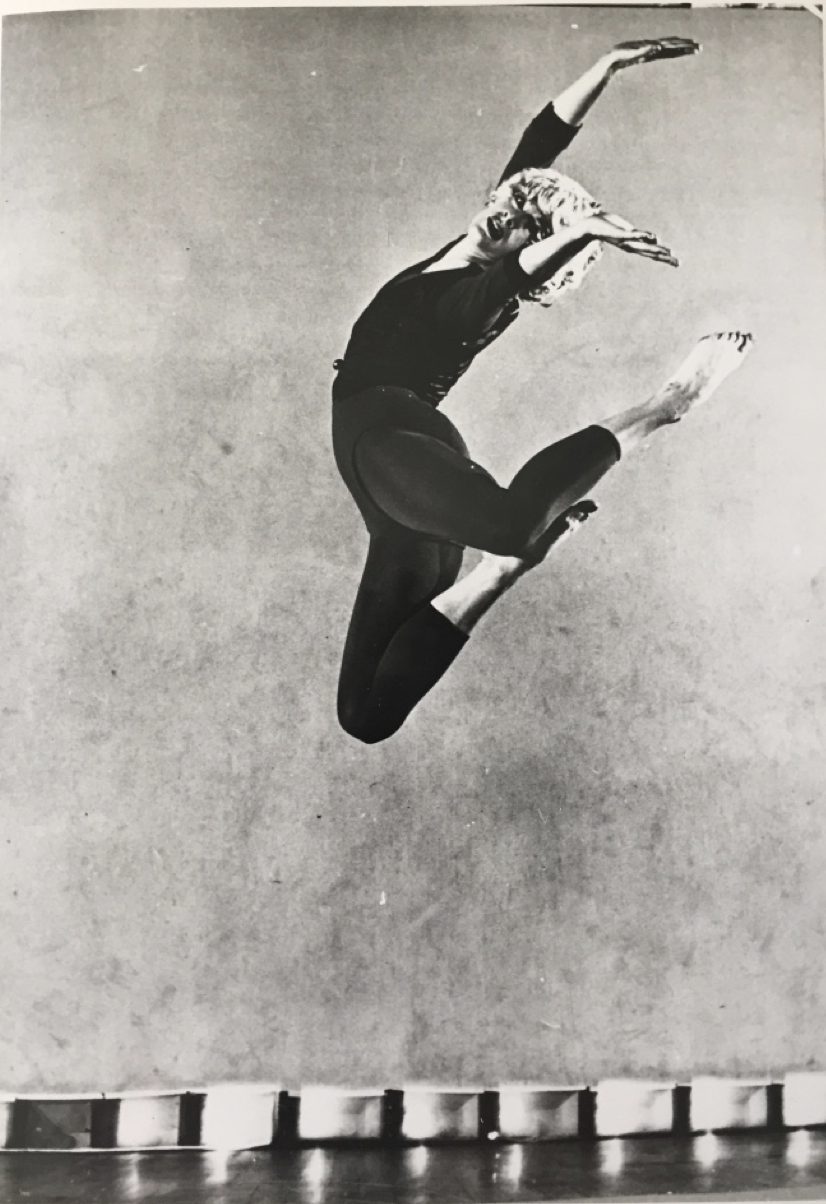
PBC: As I recall, when Murray was choreographing, he said something like, “Do your best jump,” or something like that, or, “I need a jump here.” You know, I don’t think he told me exactly what to do. It was he wanted somebody in the air at that point.
NS: Then Peggy’s in the air. That’s wonderful. (laughter)
NS: I’m going to throw something out to you, which is a -- a quote from Nik that I find provocative and see what your reaction to it is. He’s talking about where he is in the universe.
PBC: Mm-hmm.
NS: And he says, “Your welfare,” meaning your artistry.
PBC: Mm-hmm.
NS: “Your welfare is greatly a matter of whether your aesthetic vision coincides with the whims of history in progress.”
PBC: (pause) I suspect that this is very true, that art has always been on the whims of history and whatever the culture is asking for at that particular moment.
NS: That said, how would you describe Nik’s theater in the ‘whims of history?’
PBC: Ah... well, Nik was sort of suggesting examples of a more modern look at art than -- particularly dance [01:10:00] art -- than was around. I think that’s why he has so many imitators, because he was showing a way of looking at things that wasn’t common then but has become more common now. He has a lot of imitators.
NS: Yes.
PBC: We look at things either on the stage or on television or something, and we say, “Well, Nik thought of that first. Nik did that first.”
NS: I can’t tell you how many times that’s happened (laughs), with friends or by myself or watching the Super Bowl halftime show.
PBC: Oh, God.
NS: You know, or an Olympic closing ceremony --
PBC: Mm-hmm. Yeah.
NS: I am reminded or it’s reflected. You know, it’s like that was a spark from Nik --
PBC: Mm-hmm.
NS: No, I think certainly you’re not alone in saying that --
PBC: No, no, no.
NS: -- but I think that it’s worth noting that within the crucible that you found yourself -- in that – 50s, early 60s, -- that that was not something that was on the stage in New York at theaters.
PBC: Absolutely not. And in this case, he’s sort of creating a history, but he couldn’t have done it except that it was the moment to do it.
NS: Yeah. I think you’re…
PBC: We’re ready for it.
NS: He also says in this interview, when he starts to talk about his aesthetic, -- talking about it with any knowledge or accuracy about his aesthetic in depth is never guaranteed. You can’t guarantee that it’s going be articulated. And I think that part of the reason is something that always comes up when I discuss dance with people, and ask, “What was it like?” or, “What was the feeling like?” or, “What did you see that’s changed?” or -- is that those -- dance is just such a temporal art. It’s temporal and temporary.
PBC: It is. It definitely is. However, it’s probably -- well, to my mind, it’s the greatest (laughs) --
NS: Of all, right?
PBC: Yeah.
NS: Are there other choreographers or dancers that intrigue you as much as Nik and Murray? And not necessarily contemporaries of theirs, but nowadays or if you see a dancer --
PBC: No, I sort of stopped going to modern dance about, well, maybe 20 years ago or something, because I just got fed up. I just didn’t feel that they were saying anything useful.
NS: Does another art form excite you then? Was there something that was --
PBC: Oh, I happen to be big on ballet now. (laughs) When we moved down here, I looked around for modern classes and -- (laughs)
NS: How many children at this point? You have --
PBC: Two. And I got a little tired of people -- modern dancers -- telling me I was doing it wrong, because I was doing it Nik’s way or Hanya Holm’s way. I was in that --
NS: That lineage.
PBC: And the Wigman-Holm-Nik-Murray lineage. [Mary Wigman, 1886-1973] And so I decided I didn’t want to switch over to anybody else’s, so I started taking ballet instead.
NS: That’s appalling. Not your choice, but that someone would say you’re doing it [01:15:00] wrong.
PBC: I know. It is appalling, particularly for a modern dancer.
NS: Yes.
PBC: But, you know, “Oh, no. You’re not supposed to turn out here,” or, “You’re not supposed to do this, and that and then the other thing.” I felt it was ridiculously rigid. If you go to a ballet class, they’ll say, “Oh, well, that’s Royal Ballet, and we’re doing Vaganova,” [Agrippina Vaganova, 1879-1951] so you don’t feel badly about it, it’s just, you know, “It’s not Cecchetti [Enrico Cecchetti, 1850-1928] it’s Vaganova – so you don’t feel badly about it because it’s just a different style. But if you -- when I got down here in the 70s, I was being told I was wrong, so I think I gave up. (laughter)
NS: Oh, gosh. Well, that’s a sad, sorry state of affairs with dancing.
PBC: Well, there were other reasons, too. I mean, after all, when I’m aging out here, it’s much easier to stand up in class than roll on the ground. (laughter)
NS: Yeah. (laughs)
PBC: I sort of gave up rolling on the floor for a while back.
NS: Well, and also at some point your extension at the barre doesn’t have to be, you know, at 65 [degrees], it could be at 40 [degrees].
PBC: Oh, yes. If that.
NS: You study ballet, but do you go to dance concerts, to ballet concerts or --
PBC: Tup. We go to see ballet. And we particularly like the nice old ones. The Petipas. [Marius Petipa, 1818-1910] The modern ones, I mean -- I don’t know. A few of them are okay, but so much is just -- there doesn’t seem to be anything underneath it. It just seems to be a lot of running around.
NS: Do you -- what do you ascribe that to? Do you think -- when you talked just earlier about the specificity of Nik in the late 50s, that he is of a particular time? I wonder, in terms of the times we are living in now, whether -- what kind of art form gets produced in this atmosphere--
PBC: Yeah.
NS: -- or in the ether.
PBC: I don’t know. I don’t think I like it. (laughs) But I don’t see enough, I guess. But I see it a lot on television and stuff and I don’t know. (pause) It’s just…I’m not thrilled. I mean, I’m still thrilled to be dancing myself, because I can get intense pleasure.
NS: The molecules are moving inside you.
PBC: Yes. And, well, you as a dancer probably know that there is a point -- it doesn’t happen often, but there is a point when everything will go together exactly right. And I can still get that. In class. I’d rather get it on the stage, but I can still get it in class. So this is very, very motivating.
Do you have a train?
NS: Well, I think that was a great place to stop.
END OF AUDIO FILE
[1] During this interview Simon and Chambers are often looking through scrapbooks.
[2] Spoleto Festival of Two Worlds, Spoleto, Italy, June 1962.
[3] Music and Dance Festival, Montreal, Quebec, Canada, August 5, 1961; Comedia Canadienne, Montreal, August 7, 1961
