NS: This is Natasha Simon, [May 30, 2018] and I’m sitting in the living room at 11 Rue Foch in Saint-Mandé -- outside of Paris. And I’m sitting down with, --
CC: Carolyn Carlson. (laughs)
NS: -- Carolyn Carlson in her living room. And this is her story -- well, it -- we’ll let her tell her story. But I wanted to ask a couple of questions before to set the stage here. And I always ask this of people that I’m interviewing, because we’re talking about Nikolais. What do you think Nikolais learned from you?
CC: A lot.
NS: Okay.
CC: I must say.
NS: Good.
CC: Maybe I’ll start from the history.
NS: Sure. Sure.
CC: Okay. I must say, you know what I wrote down? I was looking for Nik, and Nik was looking for me. I was in the university in Salt Lake City, and my mother was great. She’s the one that found that. I was two years in a junior college, studying poetry and theater and philosophy. But there was an edge -- there was something I missed. So she said, “University of Utah has a great dance department.” Ballet, which I was doing at San Francisco Ballet, and modern dance. At that time, it was modern dance. And --
NS: Is that because you were growing up in San Francisco?
CC: Yeah. And I was studying in a Los Altos University, and then I took the car every day in San Francisco. But it was strange, San Francisco Ballet. After two years, I was at the barre doing a port de bras, and I said, “Excuse me, I have to leave.” It was a revelation to me. I could not follow everybody. Every day was the same code: plié, relevé, open your arm. And I said, “Oh, this isn’t for me. Nope.” So, I left. And I told my mother I wanted to -- she was a great lady -- that I wanted to find something else in university. So, she found University of Utah with Joan [Joan Woodbury, 1927-2023] and Shirley [Shirley Ririe, 1929-2025]. And so, I went there. Again, philosophy, poetry, theater, western civilization, you know, I had all these college degrees. And then I took ballet again. By a great master. He was in San Francisco. I can’t remember his name even. It’s somewhere in my diary. You know, I’ve kept a journal since --
NS: Oh.
CC: -- 1965. Well, no, starting with Nikolais. I have all these years. Christian -- Christian. I don’t know. But there was such a joy in his teaching that I -- I found ballet again on -- on another level -- because he was really a great piano player.[1] And then at the same time, I was taking class with Shirley and Joan, which was really great. It was creative. We were doing things. Anna Sokolow came. [1910 – 2000] She’s one of the people that changed my life. You know, we were nice college girls. I mean, this was ’64.
NS: Uh-huh.
CC: ’63, ’64. You know, the big bouf-- bouf,
NS: Yeah, yeah.
CC: You know, the hair all piled up and the lipstick. Anna Sokolow comes in. She said, “Just take off the -- fucking take the lipstick -- put your hair down. I want you to be wild.” And us college kids were like, “Oh.” So, she’s -- she gave me a click. Because we were nice little college kids and everything. But she said -- uh, and I did, uh -- we did a work with her. Very -- she was just great, Anna. And she kept pu-- uh, pulling us to get into the deep poetry of movement, and not just on the surface steps. And, you know, Anna, she was a real --
NS: Intense.
CC: An intense woman. So, we did something that was quite incredible. I did a thing with my hair all out like this [gestures a ‘fright wig’] with five men. Absolutely crazy solo. And so, that was kind of the beginning of a wake up. And then at Utah Joan said -- uh, I didn’t -- you know, I didn’t know who Nikolais – I kind of read -- but I didn’t know who he was. And Joan said, “You have to stay this summer in Park City to have a workshop with Alwin Nikolais.” So, I said, “Okay.” And hardly didn’t have any money. After the evening of --
NS: The story of every dancer’s life.
CC: Yeah. The five o’clock. I was waiting on bars in Park City, you know, to make -- okay. [00:05:03] But the first day with Nikolais, Natasha, was a revelation. My God. My God. He was telling about vertical. Stand up and feel the presence, you know? And, no one ever fed these words, you know, in ballet. Okay. Be up, move your chest, uh breathe in, whatever. But Nikolais, his words were close to what I was studying in philosophy. He -- he -- he was a great speaker. The things he said about time and space, it went so deep. So, for me, it was great because it fed -- I’m not talking about even moving -- it fed my imagination and gave me back my poetry in another sense.
NS: Do you remember those phrases that first day, beside when he would say, “The vertical. I want the -- the sense of verticality?”
CC: Yeah. The -- the presence. There’s a light in your spine. You know, stand up. Stand up. You know, that’s part of the, um, uh, to be.
NS: Mm-hmm.
CC: D’être.
NS: Mm-hmm.
CC: You know, and then we -- we were walking. The second one was a walk. How do you walk without showing the legs? The -- the whole body goes through the space. That was hard. That was hours, hours of working. This workshop was from seven in the morning. I was washing dishes in the morning to make money and in the evening. But, this was so intense. Two weeks of Alwin Nikolais. I learned my life. My life. Because at that moment, Nikolais opened the door. I didn’t know what I was going to do. I wasn’t really interested in the teaching or anything. But he opened this huge door. But it’s still open. And I just fell in love with this man.
NS: You walked through it.
CC: I walked through it, and I’m still walking through it. It’s still open. And for me, he was everything. And the joy of doing the motion, shapes, and I want to say though, he really liked me also because I -- I guess coming from classic, but I wasn’t really classic. I had these lines. You know, the famous -- I have the lines. I had the shapes. I have a long back. And I could do all these things. And when I went to New York he used me quite a bit for that. And, um, even -- okay, that’s later. Okay, Park City was finished, and I was just overwhelmed. Overwhelmed.
NS: Was there a -- because he just fed -- I mean, his menu was --
CC: incredible.
NS: -- extraordinary.
CC: And see, I had never met -- because also, I was in philosophy. I was very interesting -- interested in questions that you can’t answer. And Nikolais gave me a palette, which was so vast. I mean, improvisation on slow time, fast time, interior time, exterior time, volume. I found such a wealth of knowledge. And for me, they were concepts, they were poetic concepts because that’s who I am and, I -- I see things -- the world through a kind of poetry. And, uh -- and I did expect --
NS: Would you have to find -- because that seems to be -- I -- I must to confess to having seen some YouTube interviews and some other histories. And the word poetry comes up an awful lot for you.
CC: Absolutely.
NS: It -- it’s, uh -- absolutely. And so, what distinguishes poetry from prose for you? Or what distinguishes poetry from -- or how would you define that?
CC: Well, I’ve written prose also. No, but what I like about poetry, prose --
NS: Or can define for you --
CC: The haiku. The haiku. It’s short, direct, to the point. I mean, I can write five lines. I do write pro-- I wrote a book on Mark Rothko. About the painting. Forty-seven pages. Prose. But usually, my two books I have, they’re based on poetry -- haiku. See, when I was in New York with Nikolais, I discovered haiku. And the -- this was so -- I mean, it was like Nik. You know, unique jest. The unique jest.
NS: Yes. Gesture.[2]
CC: When you read haiku, it goes straight to the heart, with few words, which gives 1,000 pictures.
NS: And that’s where you connect?
CC: Absolutely. Absolutely. I remember we used to do these things. Nikolais asked us to do -- to do a carnival or a haunted house. [00:10:03] I thought it was so interesting. A carnival, like the Catha-- and the haunt -- I loved the haunted house, you know, being this mystic. The haunted house and doing all this? So, also, Nikolais had a sense of poetry. And I must say he was in my old house in Paris. When was it? Let me see. It was 1986 I think. And he saw Blue Lady [1983] that I did. And he says, “You know, Carolyn, you really have a spiritual bent. You’re a poet.” And I said, “Thanks, Nik.” Because he saw -- he saw the work. So, Nik, but that’s where -- we had a great affinity because, you know, most people don’t know -- I’m very close to Carl Jung. I’ve done two pieces with Carl Jung. I love his philosophy. And what I wrote down --
NS: With -- and also with Bachelard --
CC: Gaston Bachelard. But you know what’s so incredible? Carl Jung always worked on the invisible made visible. And you know what I loved about Nikolais? Not many people speak -- but he -- he read Carl Jung. Um, you know when we were in the sa-- I was in the "sack" for seven years.[3] No, really. And I think it was great because for me, it was visible. But it’s also the act of disappearance. The ego disappears. Because you don’t show your face. And that’s another thing I learned from Nikolais. Also, okay, the teaching and the work. You serve the form, of course -- everywhere. You serve the form. I don’t want to see your personal history. I don’t care what you do. Close the door to your personal life. I wanna see the work. And it’s another thing. I found this so amazing because in ballet I was not quite comfortable because I had to kind of smile and go out like this. But I was -- why? Why plaster on a smile when it’s not real? And with Nik --
NS: And it’s not integrated.
CC: No, it’s not integrated. So, with Nikolais, doing the motion and going inside, -- it was my way. Absolutely my way. And I just did a piece called The Synchronicity.[4] You know, Carl Jung. The powerful meetings in your life. All the company knows when I met Nikolais. Changed my life. Abs-- from -- like this.
NS: Turned it right side up, essentially. (laughs)
CC: Turned it way upside down. Right side -- right side up.
NS: So after two weeks, you were smitten in Park City.
CC: And then Nikolais came back the next year to teach a longer workshop in the studio. And I was so happy. Instead of doing one composition -- I did two. Because I wanted to make sure, like, on time. I was so happy to do this, and I said, “I’m gonna do two.” Nikolais loved me for that. I think he already saw something in me that -- especially the shapes and the time pieces. I’m not saying anything that I’m -- was the best. But I’m saying there was something that he wanted that I could do: improvisation. I understood him. I -- I remember at Henry Street Playhouse, he took most of the things I did. We improvised. And -- oh, I have to tell you one thing very funny. I -- I just love this. Nikolais, he asked to do a 30-second solo. Thirty seconds. What a challenge, huh?
NS: Very.
CC: Has a beginning, middle, and end. God. What’s a 30-second solo? No -- I was the -- okay, how -- what can I do in 30 seconds? I had my friend help me. I had about a -- a -- 100 balloons on me. They all blew -- it was like this. And I came in from the door. There was a big box, and I came in like this, and I started popping them.
NS: Popping balloons?
CC: Pop, pop, pop, pop, pop, pop. In the end of 30 seconds, I dove in the box. Nikolais was laughing so hard he was crying. He couldn’t say anything. He laughed, and laughed, and laughed. I mean, me coming out with these balloons and picking up -- and he laughed so much he was crying. He says, “You know what, Carolyn? You have done 30 seconds of genius.” (laughter)
NS: What did he learn from you?
CC: I know. I know. I know.
NS: He learned a lot from you.
CC: No, but -- because, you know --
NS: Well, it --
CC: It’s funny, my finish. But -- but I can be a little --
NS: You gave.
CC: -- crazy. A little bit out.
NS: You gave to him.
CC: But, you know, it was so mutual. I -- you know, someone else -- wha-- what happened if you wouldn’t have met Nikolais? Life doesn’t work that way. I did. I did. And even to this day, Natasha, he -- he’s still -- I do his teaching. [00:15:00] It’s eternal. The periph-- emotion, everything. Time, space, shape, and motion. It never goes away. And I see this younger generation now. They just lap it up like crazy. And most of them -- uh, you know, there’s kind of still a wave. This conceptual stuff. You know, they stand there, put the arm up. Ah, what a fuckin’ bore. Sorry.
NS: It’s okay.
CC: Because, if you haven’t got presence you can’t do it. You’re boring the public. And there’s such a wealth in Nikolais’ uh --
NS: Philosophy.
CC: -- philosophy. And even, teaching -- last year, I taught three weeks: composition at the end. And the kids don’t know what to do. And I said, “You don’t know what to do? Tell me your idea.” Okay, they tell me the idea. “Okay. Take it in terms of space and time. Let’s see what you can do.” And for them, it’s a revelation. That’s why even today, when I choreograph, it’s endless, the invention. I go -- I still work from poetry and ideas, but it -- it’s always the source. But also, poetry’s about time, space. And it -- it moves the, how do you say it moves perception? But see, that’s what I like about Nikolais. He -- he was so perceptive and met also in his criticism of everyone. I mean, a good criticism. Why it didn’t work.
NS: Do you remember a composition that didn’t work for you and how he would help you develop it to be something that worked?
CC: Okay, after that, I went to Henry Street Playhouse. I saved money to go, and I didn’t know my name was on the company. I was just going to go study. And my name was on the board. I couldn’t believe it.
NS: (gasps)
CC: He knew I was coming, so he says, “Okay, you’re in the co—” He didn’t tell me before. I do remember one time, it was on weight. It -- it was very interesting, on weight. And so, I was going, dig, and doing all these things. Pressure, weight. He said, “It’s okay. We’ve seen it a lot. How can you be like a heavy iron pole?” Have you -- it was incredible. (grunts) So the whole time. You know -
NS: It was a restricted --
CC: Restricted. I’ll never forget that. He says, “Okay, this is your body. You’ve given me something unique. This is -- you have arrived.” Because I think he knew I could do many things. I mean, I was very gifted in following that. But he -- he pulled me even further. And I have to tell you one story too, which is just great. I was with my friend, Lynda Gudde [1942 – 1996]. You know, this was in the ’60s, the hippie generation. And we met Andy Warhol at Nikolais’ place. And we went to see The Living Theatre.
NS: Julian Beck. [1925–1985]
CC: Julian Beck. You know, in those days, it was incredible. They did a piece -- they were all naked. There’s smoke coming out from the seats. They say, “You don’t have a passport. How can you live? How can you do this?” You know, and Lynda and I were sitting -- woo. Wow. (laughter) You know, it was something. I bet -- really revolution. I mean, Julian -- I was just dumbfounded. Here is somebody -- okay, Nikolais was a genius. We were doing other things with lights. But here it is. I -- we went back to the, uh --
NS: Well, I -- my understanding -- he -- it was dangerous. Living Theatre -- there was danger there.
CC: Yeah. D -- da-- danger. And I liked it. Because he really said something. You -- you don’t have a pass -- if you don’t have a passport, you don’t live. You don’t have proof. When were you born? I thought this was great. So, we went back to Henry Street Playhouse. And there was a discussion in composition, and then I said, “You know, Nik, we saw Ju-- Julian Beck, The Living Theatre. And what was so great? They were in the public. So, we really felt the energy. Contact. They were touching us.” And I said, “Why don’t we ever do something like that in dance?” And -- and Nikolais said, “Well, I’ll tell you what. We’re gonna have a lesson for two days.” It was the most incredible lesson I’ve ever had with our group. Okay, there was only 12 of us at that time. I think Phyllis [Phyllis Lamhut, 1933-] was there then. He said, “You can stay on stage.” I wrote -- these are – “You can stay on stage and penetrate your energy to reach the public on another level. [00:20:02] You’re gonna do it.” My gosh. We were throwing out energy, and Nikolais said, “No, no. It doesn’t work. Go, go, go, go.” Signal his eyes out, which Murray [Murray Louis, 1926–2016] had. He was great.
NS: Yes.
CC: So, Nikolais -- and then he would say, “No. Doesn’t work. You don’t touch me. You don’t touch me.”
NS: He’s in the house?
CC: Yes.
NS: He’s sitting in the house?
CC: No, I have to tell you. Wait, where was that picture? Wait. Yeah. Here he is. Here’s Nik -- sitting in the house. Henry Street Playhouse. The class is here, and someone’s on stage. He would say, “No, no, no, no. I don’t feel it. Again.” So we were throwing out energy, just standing, going out. “That’s it. You see? I feel you. You touched me.” This was one of the greatest lessons I’ve ever had because I learned on stage, which I teach today -- how -- okay, it’s also charisma. But it’s the intention of your mind reaching out. And it’s sharing. Generous. You go out. Do you know someone’s out there? See, this is today what I find hard because sometimes, there’s a wall. And the people, they stay in their living room and they do their thing. But it’s not reaching out. And Nikolais was always for this, even though, we were in the sack [Noumenon]. But he says, “Okay, but your energy has to be a little bit stronger inside.” “Nik, but you don’t see us.” (laughter) But see, Nikolais was incredible. And I remember, what was it -- Imago. [1963] You know, we were standing like this.
NS: On a tilt.
CC: He said, “But you are the tilt. Feel the tilt.” And so, it was, uh -- it was incredible.
NS: So, what you’re describing, however, is that it’s not enough to intend to do something.
CC: No. You are it.
NS: -- you have to be it.
CC: You are it. Well, it’s like Marshall McLuhan (1911-1980), that big thing. The -- the messages in the light bulb. Not the light. The message is the light. And, uh, see, the -- this is the incredible genius of Nik. Also, to speak like that. You know, he almost never moved. He was on the drum, or the piano. And we always laughed. He talked about vertical. But Nikolais walked -- he -- (laughter)
NS: He had it back -- backward. Yes.
CC: He had to stand back. Yeah. Yeah. He had to walk backwards and -- no, but Nikolais, the way he spoke, you reach out, but can you give your soul? He didn’t say soul. Uh, I said that. Just get your inside out to share with me, please.
NS: It was a very polite demand.
CC: Absolutely. Polite, but you know what I was going to say -- his character -- what I wrote I down -- Nikolais was very austere. Very austere, to the point, but gracious. And he always used to sit like that.
NS: Ponder. Sitting with his arms crossed.
CC: His two fingers. Two fing-- But also, he wasn’t a leader who you were afraid. But it’s -- was such a respect. He was -- okay, he was like a king. He was kingly in his presence. And you always believed in him. And, oh, God. I know when I left. I had seen Robert Wilson here. [director, playwright, 1941- ] I was with Nik for seven years. I was with John Davis at the time. I was working -- and when we’d get back, John Davis [1948-2013]. He helped me in the Paris Opera. Couldn’t have done it without him. And, um, in ’71, for -- I went back –
NS: John was a tech lighting person at the Space [The Space for Innovative Development[5]].
CC: And then we fell in love. We had fell in love -- Nikolais was a little bit jealous of it. I remember in ’71, I went into the office. I told Nik I was leaving. So hard. I told Nik that I -- I felt I have to leave now, I have to do my own work. And Nikolais had tears in his eyes, and he said, “No one is irreplaceable.” [Pause] Oh. How mean -- mean. You can replace me? But it -- it was -- I -- I remember -- and we were both crying. It was -- but, you know, it’s like, Nietzsche said, “You have to cut the cord.” And he gave me so much that I was done.
NS: What was the decision -- it obviously was a hard decision to make.
CC: Right.
NS: Do you remember the inklings of it and what -- why you decided you had to leave? [00:25:01]
CC: I wanted to choreograph. I did two big group works at the Henry Street Playhouse, which, twice a month, you could do anything you want. Those times were free. I did something with 15 people with this electronic music. Nikolais was flabbergasted because it was 50 minutes. No one did 50 minutes at that time. Nobody. And he said, “Oh, gosh. You are a choreographer. Go on.” And then I saw Robert Wilson -- here in Paris. Well, we were with Nikolais [at the] Theatre de la Ville.
NS: So, you were touring at that point?
CC: Touring.
CC: And then I saw Robert Wilson [at the] Theatre de la Gaite (then, now Gaite Lyrique) [00:25:36]. He did this slow -- it was Deafman’s Glance, Le Regard du sourd [1971] Deafman’s Glance. Five hours of slow motion. I -- I was so inspired. And I looked at him, and I just felt this wealth of creativity in me. I felt I had to do my own work. So John and I went off together. We taught in -- it’s a crazy story. I was in Germany, London, at The Place, and then Anne Beranger [actress, producer, 1925-1983] knew I was in Paris then. She invited me with the company. We did something at Avignon -- which caused a revolution. I worked with John Davis. It was based on Nietzsche. Believe it or not. But still, the Nikolais principles. But I really went off on my own because it was -- I used theater people also in a very kind of strange piece. And then I went back to London to teach. And then Rolf Liebermann [Swiss composer, 1910–1999] knew me from Nikolais because, uh -- that’s a long -- ’71, I was in (inaudible). And Rolf Liebermann said, “My gosh. Who’s that?” Nikolais said, “She’s incredible.” So, I was teaching in London, and Liebermann came over, and he said, “I’d like you to do work for the Paris Opera.” He was just there. And being very American, I said, “No, I’m not ready. But I’ll do a solo.” Just laughing. So, he said, “I’ll buy it.” So, it was a flute solo, Density 21.5, Edgard Varèse on the whole program. [Carlson choreography 1973] And Natasha, I don’t know what happened. The French public just fell in love with me. It was amazing. It was incredible. It was because I had the line, the design in Nikolais’ thing. It was a solo of seven minutes. I worked two months with John. Can you imagine? Now, I can do (laughter) one hour. Two weeks. Uh -- and then, I was also --
NS: But can I interject?
CC: Yeah, yeah.
NS: The -- there’s a trajectory from 30 --
CC: Right.
NS: -- seconds --
CC: Yeah.
NS: -- of composition --
CC: Yeah, absolutely.
NS: -- to the seven minutes --
CC: Absolutely.
NS: -- right --
CC: Yeah.
NS: -- to the hour.
CC: Yeah, very nice. Ah oui, ah oui. And I still always do what Nikolais does with my company. He always improvised before. And it was great to have Henry Street Playhouse. (gasps) He -- he would be standing with a microphone and, “Could you give me some turns that -- that go with this?” And we were all turning. He said, “Carolyn, I like that. Remember it, okay? Okay, Bill Frank, I like that.” So, we were creating on the spot. And you know what was so great? Nikolais would go home and do the music on the first Moog synthesizer. And we couldn’t wait. He came back with the music. And of course, you have (imitates music) turn. (laughs). So, we didn’t always count. All the cues were in the music. And, uh, of course, we did the costumes with Frankie downstairs. [Frank Garcia, 1929 – 2002]. And to this day, I -- I do as Nikolais -- we improvise weeks, weeks, to gather material.
NS: The intention, however, is that it’s been in gestation for a while.
CC: Yes.
NS: You thought out what it is that you’re interested in exploring.
CC: Right.
NS: I think sometimes, it’s like, well, what is it she’s saying or what is it she means? But I think the real question is what is it that you’re interested in exploring?
CC: Me?
NS: Yeah. I think that what happens for people who aren’t used to seeing dance is that people look at it, and then they say, “Well, I don’t know what it stands for,” or, “I don’t know what it means.”
CC: But it shouldn’t be there.
NS: Right.
CC: Because we’re too used to doing the boxes. Putting a label on it. And usually, I have no program notes. I don’t like program notes because people have to see what they see, but without any judgment. Most of the people afterwards say of the show, “I don’t know what it means, but I -- I go away with something.” [00:30:03] Which is good. So -- and that’s what poetry’s about. And you can’t exactly pinpoint a -- the poetry because it goes somewhere else.
NS: And -- and it resonates for different people in different ways.
CC: Ah, oui, oui. And it’s strange because I think also of Nikolais, he had such critics and they called him dehumanizing in the ’60s, dehumanizing the thing. And I never felt that because I never felt more strong in my life because I was serving something. So, what do you want to see? A face?
NS: (laughs)
CC: Yeah.
NS: Yeah.
CC: And -- oh, that reminds me of Trisha -- dear Trisha Brown [1936–2017]. She did a solo for 20 minutes backwards. Was that great? You don’t see her face. (laughs)
NS: Exactly.
CC: But you know what happened? When Nik went to London -- we -- we were there in the, what, ’70 something -- I don’t know. I think it was -- I think it was ’69. Everyone showered great things on him. He came back to New York. All of a sudden, he was the great psychedelic father of lights. He was recognized. How do you like that? (laughs)
NS: I think when people start talking about, “Oh, this -- that light show was fabulous,” or “Did you see what happened at the Super Bowl or at the Olympics?” and a lot of people I’ve talked with who’ve worked with Nik say, “Oh, yeah, well, we’ve done that. You know, Nik was exploring that back then.”
CC: I’ve always believed in him because of his mind.
NS: Yeah.
CC: Uh, I don’t know. I just -- you know, my friend, Lynda Gudde, she was with Anna Sokolow. I was with Nikolais. We always had this -- you know, because Anna was like this. She was very emotional. Rooms [1955] and everything. But I said, “I -- I -- I prefer Nik because I feel open. I can -- be --” So, we always had these things. “Oh, Nikolais, he’s too abstract for me.” I says, “Okay.” So -- (laughter) What was I gonna say about that? But Nik, um -- I -- you said one thing that I have to say, it’s interesting. Because usually when you see a performance of yours you can’t remember everything. I know I did Blue Lady, the -- the solo. Everybody remembers the red dress because I come out and wind up. You know, that’s very Nikolais. Forever. Uh, but -- and Nikolais, he remembers so much his lights and his effect.
NS: Yes.
CC: Um, his -- his, um, beauty and, um, this wonderful abstraction that you really didn’t know what was happening. Like these sacks. What an incredible idea. And also his things with the mirrors. What’s the name of the piece? Extraordinary.
NS: Is it Crucible? [1985]
CC: Crucible, yeah. But it’s incredible. Dancing on the plates. [“Discs” from Kaleidescope 1956] And I remember us three ladies doing the costumes with the loops. [Vaudeville of the Elements, 1965] I mean, you never forget those things. But this is what I learned from Nikolais too. He was so visual. Totally visual. He would work with motion and all that, but everything is so seen, you know?
NS: He painted that canvas that is the stage in ways that --
CC: Absolutely.
NS: -- I don’t think anyone has.
CC: Uh, no. And this is ’60s. Fifties, ’60s, totally new. No one was doing this. No one. You know what I think also? I think -- because Nikolais sometimes talked about -- he talked -- one time, he was playing the piano, and we say, “Great.” You know, and he played for silent movies. So, his eye when he’s playing -- his eye was playing for the figures moving. And I think that’s part of his love for doing music with the dancers. He’s one of the first people to buy the Moog synthesizer. He got this from California. It was just new. I remember (gasps) John Davis was helping Nik splice the tape together. And John Davis had coffee and he was reaching over for something, and he spilled coffee on the tape. You know, in those days --
NS: That was it.
CC: -- the tape was it. Nikolais -- we heard this big scream from the light booth (imitates scream). And Nikolais had to do it again. Oh, and poor John. It was terrible. And finally, Nik said, “Okay. [I’ll] just do it again.” (laughter) Yeah, they were trying to clean it up with Kleenex. But it didn’t work. [00:35:02] To this day, I -- I choreograph. I get the best lighting designers. All my costumes are original. And, the set designs. Now’s the mode everyone’s wearing jeans and a t-shirt. Everyone goes to H&M. They buy all their clothes. But I still -- I have all the costumes made because there’s something, you know, just unique.
NS: Which is part of the heritage too --
CC: Yeah, absolutely. It’s my heritage.
NS: The Nikolais heritage. I was watching the tape yesterday of, what was the name of it? Victoire Des Signes [1997] [00:35:50].
CC: Isn’t that incredible?

NS: I was so struck by the cost-- well, I mean, everything is extraordinary.
CC: Oh, Olivier Debré. [French abstract painter, 1920–1999]
NS: The costumes, the set design. It reminded me -- I was telling you -- The -- you know the phrase --or the book Exaltation of Larks?
CC: I don’t know. Exaltation of Larks. Beautiful.
NS: It’s a whole list of what do you call a group of bears, or what do you call a pod of whales or a pride of lions? And I don’t know where it came from, but I was watching the tape, and I said, “My God. It’s just like An Exaltation of Larks, except it is a ‘Parliament of Dancers’.”
CC: Ha. Wow, wow.
NS: When the groups come out in those black and white costumes-
CC: Original Debré. Every one is unique.
NS: It’s extraordinary.
CC: Because this is so off -- a great -- working -- okay, you know what’s --
NS: So -- but can you talk about the conception of that piece -
CC: Olivier Debré --
NS: -- and the costumes?
CC:-- reminded me of Nik, in a way.
At that time, he was 88 when I worked with him in ’97. He was incredible. First of all, he was a painter, a -- a visual. It was just so amazing to work with --
NS: Did you know him?
CC: No, I didn’t know him before. I knew his painting. But this was the idea of Brigitte Lefèvre [1944- ; director, Paris Opera Ballet 1995-2014], who was at the Opera. She wanted me to work with Olivier Debré and Olivier Debré saw my works, and he said, “Yes, I want to work with her.” Uh, very difficult because he’s a painter and he works alone. He changed the stage set 30 times. The floor and everything. And I said, “Olivier, dear, we’re working on a stage. You can’t do this.” So, finally, you know what he did? Which was genius. He got a pink floor, a pink linoleum. You know, I hate pink because my mother always tried to dress me in pink and I said, “I don’t want pink.” I looked at it. He was incredible because he was a painter, it changed blue, and red, and green. You could change it any color you wanted. Incredible.
NS: It’s like Nik and his gels.
CC: Yes. Yes. Absolutely in the gels. And Patrice Besombes [1955- ] worked with me very close on the lights, who was great. But it was very nice to do the costumes with Olivier Debré because I told him kind of these long coats. He designed -- which reminded me of Nikolais -- he designed all this.
NS: So, you said, “Olivier, I have this idea that I want: long cloaks.”
CC: Yes. Yeah.
NS: And he went back to his studio and --
CC: Oh, yeah. And every one is unique. Imagine 23 dancers. Not one is the same. They were in a exposition at the Opera not too long ago. And, you know, something really happened. I’m doing a piece for the Paris Opera. So he made something, with big square sacks with painting on it, and I said, “Olivier, the dancers have a waist. They have hips. It goes with the thing.” Did you see the thing with the bathing caps and the --
NS: No, no.
CC: Okay, I designed one of the costumes, and Nikolais -- sorry, Olivier Debré liked it very much. So, we took that. But it reminded of Nik in a way because Frankie used to work on the costumes. We tried them on. We were in the Paris Opera. So, it -- it was not far from --
NS: From the experience that you had with --
CC: -- sort of Nik’s work, yeah. Because it’s very abstract, his designs.
NS: Sure. Yeah.
CC: But when these things come down --
NS: The fly from the --
CC: Incredible. But it’s in Theatre de la Bastille, you need a huge place. The only place they’ve ever traveled is Japan. [00:40:00] They have a huge theater. But you can’t do it in the Paris Opera. It’s the Bastille. Huge. Are -- how long are you here for? Because they’re doing a Nikolais, um --
NS: Uh, Thursday night. I’m going to go. The students from Angers[6][00:40:21] -- are do-- are performing --
CC: What are they doing? Nik?
NS: Water Study.
CC: Okay. Oh, yeah. Okay. Tomorrow night already. I’ve got so much to do. I’m doing something with [inaudible], my calligraphy. I have to show you something. I do calligraphy. Uh, which is inspiration of Nik. You know, I have to say this comes from Nik. Okay. I just had an exposition. I’m having an exposition here. Nik.
[Carlson shows page of calligraphy from her catalogue]
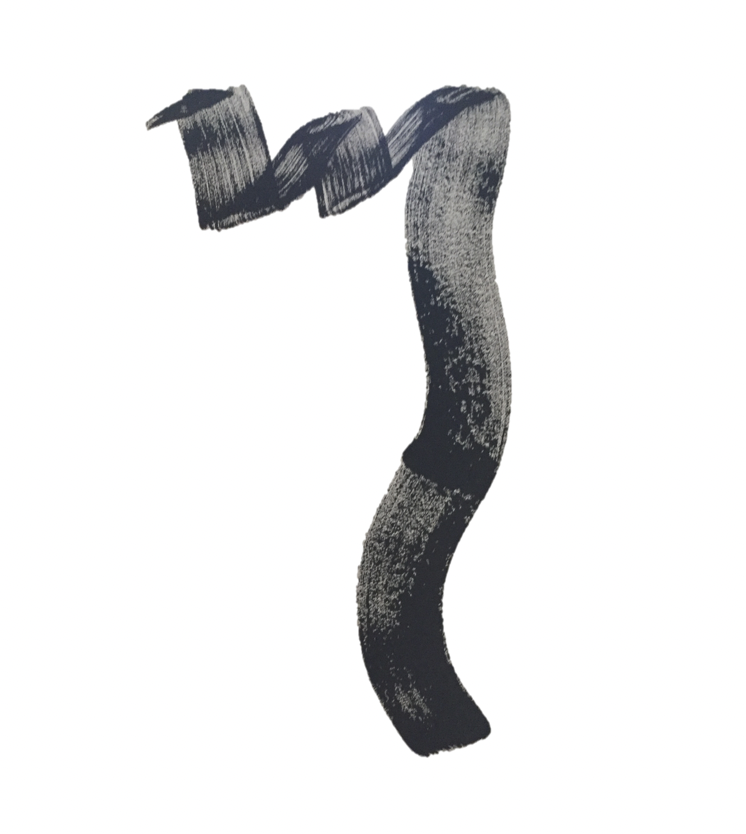

NS: Black and white calligraphy.
CC: Yes
NS: Black and white with red. Yes.
CC: But you -- you know where this comes from? When I was with Nikolais, I was studying -- but you know in those days. I -- I got anorexic almost because I wanted to dance with Nikolais. I’m losing weight, and everybody’s smoking cigarettes, and, coffee and everything. And one day in the studio I couldn’t move. I was eating cheesecake in the morning. That was it.
NS: (gasps) Oh, dear. Carolyn, no. (laughter)
CC: I know, I know. And then I was like this, [Carolyn gestures an example of finger thinness] and I with the painter friend of mine at the time. And I was in the hospital, and they said, “Uh, my dear --”
NS: You’re frozen.
CC: “-- you have to eat. You have to eat.” So, I ate. And then he took me to a Zen Buddhist class, which changed my life. Buddhism, which today I follow. There were some meditation classes and Buddhism. It was so incredible. I can’t tell you. You’re looking at an empty page. Very Nik. You’re looking at spontaneous; you’re looking at empty. But you’re making the ink with water. And this page is you. When you’re ready --
NS: You make your mark.
CC: That’s the moment. You don’t judge. You make the mark. And then, since then, I always did this kinda like a therapy. Then from Nik because I love his peripheral space. The drawing. So,
NS: Points in space, peripheral space.
CC: Absolutely.
NS: Drawing in space.
CC: Peripheral. These – what – oh, “Masters don’t die; they’re just sleeping.” [refers to page in catalogue]
NS: Oh, how sweet.
CC: This was for Nikolais. Someone asked me. But, [turns page of catalogue] that’s Density [Density 21.5 - Edgaard Varese] that I did. So, I have to tell you, see, these were the New York years. New York. New York.
NS: I -- I have my --
CC: It’s incredible.
NS: -- my cell phone camera, if -- if I could just take some --
CC: Maybe I’ll give you this, the catalogue. Right.
NS: Oh, (inaudible), uh, to, um --
CC: Okay.
NS: So that it can accompany the tape.
CC: Do you speak French? No.
NS: Yeah.
CC: Yeah. Okay.
NS: Un peu. Un peu. [00:43:32]
CC: You see, things like this -- this is only one. The -- the brush never goes down. It’s one. This is one, two. But that’s with the olive oil. That’s a mask. Nikolais. That’s for my friend who -- who was with child. Pina Bausch [1940-2009] -- when she passed away. My Japanese period. Oh, here’s Signes, the -- that’s -- that scene, all the tableaux. Yeah. Now, the Bibliotheque Nationale de France [00:44:18] has all --
NS: Has the work?
CC: Yeah. Here’s the seven sections. This is an homage of Nikolais, I tell you. No, just to say, look at the figure in between that. That’s the triptych. The universe is bigger than we are. But you see, and Nikolais -- the same time I was with Nikolais I found this thing, and I felt comfortable because it’s the peripheral. [00:45:02] So, I found this. And someone said, “Where did you study?” I have never studied. It’s spontaneous. You know I always say “the calligraphy is the skeleton of my work.” And I learned this from Nikolais: peripheral space. So, it’s nice. I can leave a trace. (laughs) It’s this organic manner of using ink on paper. And I like ink because it’s fluid. I tried to do oil colors. Takes too long to dry. It’s fire. I’m a water person.
NS: It occurs to me, as you’re talking because you have this extraordinary energy and vivacity in describing in motional terms what you were doing in calligraphy. But that also is in some way a debt from Nikolais because --
CC: Absolutely.
NS: -- when he’s sitting in the house and he’s asking for improvisation on stage and he is saying, “It’s in the space.” When he said, “How do you walk in space?”
CC: You create the space.
NS: You are creating the space. You are -- you are the ink --
CC: Yeah, absolutely. Absolutely.
NS: On the canvas there.
CC: Actually the title of my exposition that I’m doing in one week is called Brush mind no merit. Brush mind no merit. [http://carolyn-carlson.com] Which -- it’s part of Nikolais too. It’s not me. I don’t know how I do it. Is it the brush? Is it the heart? I -- I don’t know who does it. Because someone asked me one time -- there’s a huge conference, there were psychologists there. Two-hundred people. They asked the first Alban Richard [French choreographer, 1973-] [00:47:00] a man, how he creates. He went on, and on, and on, and on, on, and on, and on, how he creates. And they asked me, and I said, “I don’t know.” (claps) Big applause. I mean, I don’t know. I don’t know where it comes from. Even Nik, he -- he said improvise. But then all of a sudden, everything comes. It’s true. I owe -- and also, Nik. You know, I think when you do one thing well -- I -- seven years with Nikolais. I mean, dancer, performer, choreograph-- you do one thing well, you can go to another area, I think very easily. Because I was dancing on pap-- I draw what I cannot dance. This is an, I draw what I cannot dance. [shows more drawings] So, I mean, I can’t exactly dance this. But -- but that -- actually, this is one stroke. And this is motion. Very seldom, I have a straight line. Maybe some of the earlier ones. But -- but that is the --
NS: But most of them are motional drawings. I would like to go back to both the work at Henry Street and at The Space, and touring with Nikolais -- for you to talk about the company. Because you -- you were a soloist, but you were also a --
CC: A part of the company.
NS: -- a very strong ensemble group.
CC: Yeah, absolutely. Ah oui.
NS: So, can you talk a bit about the ways in which Nik worked in ensemble?
CC: Well, for example, not Tent [1968]. Oh, Tent was great. We worked in Florida on that. Tent was wonderful. No, no, Nikolais would be standing on stage, would be doing all of the pipes up and down. Now, we had a mask. And, you know what the difference is between the -- today, you can do any lights because you’re registered. Every tour, we were in the theater all day. I remember Patrick Odille. He did all the lights every time we did it. So, we were -- class at 10:00, 11:00, 11:00 to 1:00, and then we used to do lights in the afternoon, then it’s the show. Um, but Nik -- okay, first of all, company -- okay, I think, uh, a -- what -- Tower. Tower. [1968] It was just great to work with him. We were moving all these things, and Nikolais said, “Okay, how do you hook a circle?” So, he was usually -- he was choreographing from the public [the house] with a microphone. Or in the light booth. I don’t remember him on stage. He was telling people what to do. Now, build the tower higher. And, it was really great. [00:50:00] Verbally, he was constructing the choreography. Because I -- okay, I remember him going like this or doing a line at the -- but it’s the way he spoke which is so amazing, which -- not when I teach. I can’t sit down. I -- I always have musicians with me. But I have to show [demonstrate]. But see, he had Murray. He had Murray and Phyllis. And Murray was great in class. I was always watching him because he had this very motion fluid -- and also, Phyllis -- when I first began.
NS: What did you see in Murray that you were always watching him? To know what to do? Is that the question?
CC: Well, he had this spark. But you know, he was with Nikolais long before I was, 15, 20 years. So, I was watching him to see -- he was a master of motion and the eyes and he was so fast. He was like a streak of lightning. I wouldn’t say he was a shape dancer. He was a motion. Murray was really a motion dancer. He was great. It was interesting, Phyllis, because she was very funny. When she did clowns -- she had a wit that was amazing. I remember her so well. When she came out on stage, everybody laughed. And we did a -- a -- what was that crazy children show with Murray? She was so funny, which she still is. [imitating Phyllis] “Hey, Carolyn, now, you have to buy an apartment. I told you have to – in your old age you have to be -- security.” I just love her. She always – “Now, Carolyn,” she was kinda like a mother to me too. Really nice. And so, it was great to work with Phyllis, Bill Frank, and, Murray -- were the senior. So, I always looked to them. And I was very humble in accepting them. I was always see what they would do. And I was always following in class. But they were the pillar of the company.
NS: If you look at the history that they’re of that first generation and that you come in sort of as the transitional generation --
CC: Yeah.
NS: -- into -- into the next one.
CC: Hm.
NS: But you were sort of bridging the -- the divide --
CC: May-- maybe.
NS: -- shall we say, between the --
CC: Yeah, right.
NS: The ’49 to ’57 or ’51 to ’60 --
CC: For sure.
NS: -- and then beyond, I think.
CC: And then I came from classical, and I said in class [at] Henry Street Playhouse, I said, “Nikolais, why you not ever brush? You brush, you make the foot strong.” You know, he didn’t brush. You do the leg swings and all that. But you didn’t -- you didn’t really do -- you didn’t brush. Okay, you did an improvisation push and all that, but always the leg swings and things like that. And there were certain things on the floor, -- uh, Hanya Holm -- the -- you know, all this. [demonstrates] You know, these. And Hanya Holm uh, sorry, uh Delacroze [Emile Jaques-Dalcroze, 1865-1950] -- Because there was a technique on the floor for sure. I said, “When you stand there, Nikolais, why you not always brush?” So, he said, “Show me a brush.” And I just went back and forth with my foot really strong. He says, “Okay.” So, he included the brush. You know what was so incredible? In Henry Street Playhouse we had three wood studios. Let’s see. Two. Two studios, which were great.
NS: Upstairs.
CC: Upstairs. And –
NS: Yeah.
CC: But you know what’s -- you know what’s so funny? Betty Hayes. I would be there 8:00 in the morning. You know Betty Hayes?
NS: Betty -- Betty Young.
CC: Betty Young[7]. I just loved this lady. She had her casket [flask?] of whiskey there. She had this long cigarette thing. Oh, she was great. And I was always there at eight o’clock, just after she got there. I wanted to do the composition. Nobody there. I was there 8:00. And Betty said -- Betty Young, right -- Betty said, “Oh, God. You’re too early.” I said, “Please, Betty. I have to work. I’ll be very quiet upstairs.” So -- and one day, I came in at 8:15. Betty says, “Where were you?” So, we had a great rapport with that. And you know what was so great at Henry Street Playhouse? The two studios, a big one, smaller one, and the stage. Fantastic. You know, at that time, there were 12 in the class. Twelve to 14. Then we moved to 36th Street. And then it got to be 30 people, 40. So -- and I was teaching in the evening, 7:00 to 10:00. Nikolais says, “Okay, you start teaching.” Oh. Oh, I have to tell you a funny story though. When we were at Henry Street Playhouse, I had never taught really before, and Nikolais said, “You’re going to teach children next week, all next week.” I said, “But I haven’t taught before.” And Nikolais says, “You can do it. Just go over the principles.” [00:55:00] So, I was teaching these little kids from Harlem. But these kids are like, “Hey, Miss Carlson, what do you mean do a washing machine? You need to tell me something else.” You have people going all the time. And so, I learned to teach with these little tough kids. It was -- just was incredible. And I remember on tour one time, we were in Chicago. And Nikolais was with us. He -- he always gave conferences [classes]. We always did --
NS: Master classes.
CC: What do you ca-- master -- on stage, though. On stage master class. Everybody did. I was always great in sound. (imitates sounds) You know, I always had to do that thing – the motion and making sounds. And at the end, this little boy says, “Hey, Mr. Nikolais, how much money do you make?” And we were all bubbling with laughing and Nikolais said, “Well, you know what? I make a lot of money. But you know what? I put it all in my work.” (laughter) It was so funny -- that was the innocence of these little kids. But Nikolais always had a line for something. But again, coming back, when he moved to 36th Street – teaching, but it’s normal. It changes. You know, more people were coming in the Space. Uh, Joe Chaikin [Joseph Chaikin, 1935-2003] was upstairs and – [The Open Theater]
NS: I thought that was an extraordinary space --
CC: Yeah. Oh, extraordinary.
NS: -- with multi-gravitational people that were hanging on ropes all over the place. [Multi-Gravitational Dance Company]
CC: Absolutely. Joe Chaikin upstairs the theater. I was teaching there. Yeah.
NS: I think also, Ralph Lee [1936-2023] --
CC: Yeah. Right. Right. Right.
NS: -- puppets and masks.
CC: Oui
NS: Nik. Any floor, that you went there was always some activity.
CC: Right.
NS: It’s too bad it never took hold there.
CC: You know, it didn’t take hold. We performed in, City Theater [New York City Center] many times when we were there, but, you know, Henry Street Playhouse wasn’t the same. Because it was small, but Nik -- it was one to one. Right there. He’s in the public [house] and he’s telling you what to do. [At] the Space see, we only had the theater one week before. So it was a coldness. And, you know, City Theater, here you are and all the seats. And see, Nikolais and Henry Street Playhouse could go anywhere. He could -- because of the work we did there, he can go to London. Because he made it bigger. And there was an intimacy, like a family. But you know that once you get in the a-- so, there were so many people there.
And I remember teaching, and then the class got bigger and bigger. There [were] 35 people [in] the class, which was good because more people are experimenting. But I must say we kinda missed the master. Because at that point then, Nikolais, had someone else teach the floor. He never did that in Henry Street Playhouse. He taught the whole thing: philosophy. And I must say, even in Park City, I learned -- those two weeks, I learned all the philosophy.
Okay, compact. Henry Street Playhouse was compact. When he got to the big space Nikolais had someone else do the warm-ups. Okay, flex and reach, and all this stuff. He would come in and do the combination. It wasn’t the same. Because he didn’t -- he wasn’t there from the beginning. So, he was bored to do this stuff. But (sighs) I don’t know. Because I remember he -- he was -- started to work in the studio. It was so big. It wasn’t the s—[same] because when you have the lights -- There were no lights there. There were no -- and I don’t even remember -
NS: And [there] wasn’t the cyc. [cyclorama]
CC: -- the costume room.
NS: -- the white cyc in the back.
CC: Right. There wasn’t any of this. But as the work there, but I think his really genius works are from the Henry Street Playhouse.
NS: I do too. I think also that he had the time. I think it was that he also had the time to work on things.
CC: Maybe.
NS: On pieces.
CC: Yeah, right.
NS: Once he came back from London, as you say, and the world exploded with Nikolais that he really -- there wasn’t the concentrated time to work with an intimate group --
CC: Yeah, absolutely. Absolutely. I must say one thing. When I was at the Paris Opera for five years -- I was going to go back to America. I says, “Okay, this is it.” And then, just before that, I met Rene Aubry. [1956 - ] And then they said, “Could you do the same thing in Italy? I love what you did [at the] Opera. We’re going to Milano.” And then I thought, “Okay, Italy would be interesting.” So, I got a phone call, said, “Sorry, it’s changed to Venice.” I said, “Oh, that’s too bad.” [01:00:01] (laughter) But, you know, it was so genius, Natasha. I -- I mean, I was born under a star. We had the Malibran Theater [Teatro Malibran] for five years. I started with a young Italian company. First, there were seven. And the director says, “Italian? You never work with those guys.” Lario [Ekson] and Jorma [Votinen]. They were with me from the Opera years. We worked like hell with those people. We had the Fenice [Gran Teatro la Fenice], and then we went to the Malibran. We had a stage like the Henry Street Playhouse.
So, I could sit out and tell, “Okay, you guys. Shine. Come on, you know, go out.” Five years. And when we did the group, the director said, “Unbelievable. What did you do with these Italian dancers? They’re incredible.” We worked all the time. We went through all the principles. And the Italians were --
NS: Space, time, shape, energy, motion.
CC: Sure, sure. And my poetry in between. And working with the Italians, the work became more organic. That’s where Blue Lady came from. The work became -- I never say emotional. More, uh, poetry, like Blue Lady.
NS: What you’re hinting at is -- and the question I would then pose is: what are the cultural differences that you’ve encountered between -- the United States, France, London --
CC: Enormous.
NS: -- southern France, Italy?
CC: Enormous. I wouldn’t say -- I wouldn’t say southern France because France is very Cartesian. It grew up on putting people in boxes, definitions. For one thing, you know, [in the] United States, they usually ask what you do. When I came to Europe, they ask who you are. Difference. I found being in Europe they were really interested in more -- your background, who you are as a person. And this is -- you know, with Nikolais’ teaching, he said, “Time, space, jump out the window.” We jumped out the window. We didn’t -- we didn’t think. And when I [went to] the Paris Opera -- and this is where John Davis was genius. He took two months of French. He could speak French. And then you’ve got the Gaston Bachelard book, La poetique de l’espace, [The Poetics of Space] because it talked about what Nikolais’ principles are, so the French could understand. I talked about time, you know, time spent, it makes us ‘qu’est-ce que c’est le temps’, qu’est-ce que c’est l’espace.’ I never questioned. You -- you know what I mean? Because time and space is American. We’re very direct, and we study that in school -- Newton and all this stuff. For those guys: ‘qu’est-ce que c’est le temps.’ And I said, “Wow. So, how can I explain this?” Not Nikolais. I wasn’t gifted as a speaker like this. But “How can I --
NS: How were you going to make it understandable?
CC: -- do it?” So, John was great. John got the book. He was with me all the time. And John Davis was also teaching at this moment. So, that’s -- I created another generation. That was the first generation, French dancers. At that time, to this day, it was a revolution. And Nikolais came down to teach. He came three days, and we were downstairs in the Opera. He came to teach. Just great, and Angers later. And now, what am I talking about? Wait.
NS: You’re talking about the cultural differences.
CC: Oh, the cultural difference. Okay, um, uh -- the French were very -- yeah. Because it was so new.
NS: Yeah.
CC: You know, in America, because it’s our language -- French is not direct. I know in my poetry -- I can have one line, and then in French, it’s (laughs) like this because you have to add things. So, it was very interesting because the French dancers interpreted it a little bit different. They had another way of seeing things. And it was interesting because they knew Merce Cunningham [1919–2009], Martha Graham [1894–1991]. But no one stayed to teach. So, I was teaching. By the end, I had 50 people there. Nobody paid. I got the musician from the Metro, and they paid him something in a hat. Those were the -- still the leftover hippie years.
NS: So, when you went to Venice --
CC: Oh, it was amazing.
NS: -- talking with the Italian[s] -- what was the difference there?
CC: The Italians are much more organic. They have an -- a kind of absurdity in their thinking. And I remember Raffaella [Giordano]. I have three people in Italy who were working and who carried on. Incredible. Raffaella is a teacher. Unbelievable. She’s really great. So, she carried on the generation of Nikolais. And do you know what? The Italians are very, -- let me see -- emotional, expressive. They’re very sen-- Italians are sensuous. [01:05:00] I had four women in our company. Extremely sensuous. You know, they do time, but they have -- they have this other thing. So, it’s funny. At the Paris Opera, my work was very sharp, line, design, motion, whatever. I came to Italy. And of course, my son was born there also. So, everything -- and water. So, I really found my home there, and I found my voice. Because everything became more lyrical, and I added poetry, and, --
NS: What you’re describing as you’re talking and moving is that you become -- you became less linear.
CC: Yes, absolute--
NS: Would I say that?
CC: Absolutely. I became more earth. More earth. ‘Cause Nikolais -- a lot of people don’t think I’m fi-- a Pisces ‘cause my energy is so strong. With Nikolais, I was very air. You’re suspended for air, light, sharp, up. Well, it started from Blue Lady ‘cause I had this idea -- how many faces we have? Also, Carl Jung. We have a million faces. So, it came from there. And then my work evolved more and more, and, I wouldn’t say -- my work is not… it’s poetry. It’s images, poetic images. I never tell the story, you know, like Nik -- there’s no story.
NS: And so, when you left Venice after five years -- and you returned to France -- do you have a sense -- what did you bring back? Did you bring the organic sensuousness back with you?
CC: I brought back the organic sensuous, because ’86 to ’87, ’89, my work was more kind of theatrical. Dance theater. Dance theatrical, ah oui. Again, without a story. But it had really a strong stamp. I mostly compare it to Robert Wilson. Because I use a lot of slow motion. A lot of still images that move into slow motion. And you, see, Tandy Beal [1943- ] -- she kept on with Nik. She’s more the Nikolais thing. Or Jon Scoville, like just have a -- But I -- I really diverged from Nik’s [work] ‘cause I’m not abstract. I can’t do the abstract things like Nikolais. It really doesn’t, how do I say, -- it’s also influenced John Davis, this Density that was on the map. But it was based on Nietzsche. A bird, half man, half bird, who never arrives. But it’s totally Nik, you know, the things. But -- but the idea behind it was either Carl Jung, or philosophy, or Gaston Bachelard. But still, I -- the -- the base is Nikolais when I teach.
It was so great though. When I work with my company, Roubaix when I was there, we go through everything. Hours, hours, we do time. Hour-- hours, hours. They know everything. But then when I go to the poetics, they know what I’m talking about.

NS: Because they have the foundation?
CC: They have the base. They have the tools. They have the tools. That’s why -- you know what happens now, these young people? They kind of imitate. They work with steps. They see what someone else has; they do the steps without a style. Because there’s very few young people now who teach the company. Everybody takes like this, and the choreography is just the choreography. But I teach the company before. So, everyone has the base. We improvise. So, it’s a language. Like Nikolais, it is. We have a language. We know what we’re talking about.
NS: I -- I think what you’re pointing to too is that the -- it -- our sense as a civilization (laughs) has so sped up in time that --
CC: Absolutely.
NS: We’ve lost the sense of process.
CC: You know what? It’s interesting. Did you read Sapiens? Sapiens: A Brief History of Man -- of Humankind?
NS: No, but I will write that down. (laughs)
CC: Uh, uh, wait I get the kind -- leave this ro-- I’ll get the book. I’ll show you. It’s incredible. You have to read it. This was the bestseller, the -- incredible. He talks about -- No, you have to read this. Usually, I don’t read books like that, political or anything. But it’s incredible. But you know what’s happening now? I know even with programmers -- that’s why I can’t stand the Star Academy [French reality television show]. All these people want to make it like this. (snaps fingers)
NS: (laughs) [01:10:00]
CC: Before, we took the time. The process was agreeable because we spent the time in the process. Finally, it got to the show, and it was born. I remember more of the working than I do the final show. Like I remember Tent. It was so incredible working with Nik. “No, bring up the top. It’s not right.” I remember John during this. “No, the mask slightly to the left. Okay. Okay, now, everybody go down. But slow, slow.” Okay, performance, voila. Uh, I have -- I have to read you one se— [sentence], you know, Nikolais knew he could lift my leg. I can’t -- I -- I have two prostheses [hip replacements]. I can’t do it now. But, you know, I was standing there like this. My leg was here. Up -- up -- up in the air.
NS: I was would say that’s at least a –99, 120 degrees.
CC: And -- and I was doing this -- just the -- yeah, right -- and was just doing this. I remember Theatre de la Ville all the office used to run out this moment. I was just going down. (pliéing) Just going down. The leg was still up, and I went up again. And then I went off. (laughter) It was great. See, Nikolais, he said -- he knew -- he says, “Could you hold your leg up? And I mean hold your leg up. And just move your arms, you know.” And I didn’t even remember the leg ups with Nikolais. But you see, this process was incredible. And like I do with my company, I know the talent of each person. And each person is unique. And Nikolais -- like you work with Phyllis. She was good and -- and small, fast, funny. I mean, (refers to herself) tall, long, shape. And he -- and Murray: speed. So, he worked with each person.
NS: And what their strengths were.
CC: Absolutely. Now it’s the nature of our media. Look -- look how we have this Internet. You see a thing a mile -- everyone’s putting on Facebook and all this stuff. Everything’s going so fast. The beauty of creating is you take time. You make mistakes. You change. You go through a self process of -- kind of like rejuvenation. You go one step -- you make steps that go higher and higher. Well, this even comes from, you know, the programmation [sic]. “Okay, do it fast. I want it now. I don’t want it to cost too much,” oui? And we’re -- we’re kind of losing that sense of working with other people.
NS: Mm-hmm.
CC: I -- you know, I have so many SMS [text messages] I said, “Just call me on the telephone.” I don’t want to spend my time and my fingers. I -- I like your voice. It’s faster. We’re in communication. And, um, I don’t know why this thing of e-mail and saying you don’t want to bother anybody. Why not? You can call me on the phone.
NS: Well, it’s certainly much more personal.
CC: Absolutely.
NS: It’s not disembodied. There’s the voice. It’s not an abstraction.
CC: Yeah.
NS: You’re really talking to a person.
CC: For sure. I know that’s like Maggie [Maguy Marin, 1951- ]. I like Maggie very much. She still works like we do. She works in improv -- she works totally different. She’s social. She’s a very crazy person, but she has something to say. See, that’s what I miss today. Nikolais had something to say. Again, abstraction, but he had a form. Something to say was an idea, and I come from that. You know, Martha Graham to Paul Taylor [1930–2018] and everything, Trisha. They had a style because they thought they had something to say. Now, the dancers kinda move everywhere, and I question a style.
NS: Do you think that that’s because we are living in this particular moment, whereas say 30 years ago -- because you’re talking about people who created in the ’30s, ’40s, ’50s, and ’60s.
CC: Ah, oui. Rauschenberg [Robert Rauschenberg, 1925-2008]. Look at all these people. No. It’s evident. Look how fast we’re going. And you know what worries me a little bit? We have memory. We’re talking about -- I remember everything. The kids now, they go to the Internet, and they see a thousand things a day. By night, what did you do? What do you remem-- oh, I don’t really remember what I did today. So, we’re talking about memory. When you work deep and you work into something, you keep a memory. If you do so many things too fast, and you’re always looking at this (gestures to cell phone), it’s --
NS: Well, that’s where your Zen Buddhism comes in.
CC: Right.
NS: And mindfulness.
CC: My – Thich Nhat Hanh [Vietnamese Buddhist monk, 1926-2022] [01:15:00]. You know, Thich Nhat Hanh?
NS: No.
CC: Okay, I’ll give you a book. You have to read him. He talks about mindfulness. I mean, instead of sitting in the Metro and just put – (gestures putting in earbuds) you know why people do this? They can’t be alone. It’s a fear of solitude. Just sitting there. And it’s just breathing and giving someone a smile is one thing I miss in America. We’re in Paris. You live in the capital. If you smile at somebody, they think you’re a little bit -- (laughter) a little bit crazy here.
NS: There’s the cultural difference.
CC: Yeah, yeah. But not Italy. You see, Italy, the people are so -- it’s like a big family. A family, family. But -- but every culture has -- I appreciate France because they’re poetically oriented, and I have such fans here. I mean, uh -- really, really. And we’re sponsored by the national government. We’re one of the five companies who are supported from the state, which is great. And the only thing about France also, they have all these Centres Choreographiques. I’m lucky to be in France. If I went to the United States, these foundations -- I would never get money.
NS: Well, you would spend all of your time trying to gather some euros together just to -- make it. Which is unfortunate.
CC: But the one thing, Natasha, we’re talking about -- I hope -- you know, that’s why I feel such a responsibility to teach. Now. (pause) You know, I read Nikolais’ dance book that he taught about dance, you know what I mean?
NS: Mm.
CC: Not what I know.
NS: Tell me the difference.
CC: It’s not what I know. Okay. Locomotion is this way. It’s funny. Okay, that -- but -- but that’s natural.
NS: Sure.
CC: My vocabulary is much different from -- I remember when I read the book what it is. But I -- I have to teach this as I am now, what I learned. Because I -- I don’t -- I can’t --
NS: It’s not steps.
CC: Not steps, no. It’s like a philosophy. You go forever. You’re walking. But this is what John Davis taught me. We were working on a motion, and he said, “You stop, okay? You suspend. But it’s forever.” When I say this to my group, not stop, but suspend, but when I say pour toujours (for always), you should see the faces. I mean, it’s a moment of forever. And why not? So, instead, Nikolais says, “Stop. Suspend.” I use this word forever. But why not? It is. Because when the public see your performance, it’s registered.
NS: One of the notebooks -- notebooks that I looked at earlier, I have a quote from a theory class of Nikolais’. And the problem was for us to “stand still fast.”
CC: My favorite.
NS: It’s so difficult, and yet, it’s so clear.
CC: But you know what it is? You -- that’s from the inside.
NS: Absolutely.
CC: But that’s the presence. I still do that. How -- how can you move without moving?
NS: Yes.
CC: I -- immobile. But see, this is another thing. You know Rob Wilson studied with Nikolais? One of the greatest things I’ve ever seen. He did Madame Butterfly. [1993] His décor and his light -- he does everything. Costumes, lights, décor. It’s crazy Robert Wilson. He’s more theatrical -- of this time. Madame Butterfly -- there’s a bridge in the water. He has this guy in black standing. He’s there for 20 minutes. You’re watching him. You keep going back to him. How can this guy -- well, that’s like Deafman’s Glance. You have Sheryl [Sheryl Sutton, 1950- ] sitting with the bird in her hand. She’s there for 40 minutes before she talks or something else that happens. See, this is the -- this is why -- Robert Wilson went in another direction, which I felt even closer -- because I can’t do abstract like Nikolais. You know, the lights. But Robert Wilson has this thing. Very cold. Cold. But he has this extraordinary thing of still images and motion. Nikolais didn’t have many still images. Uh, you know, he did. You know, you do this. But it -- I mean, it wasn’t st-- and then you move. But it wasn’t stretched in a duration.
NS: It is fascinating to see the different approaches that people --
CC: Oh, for sure. See, this is the genius for Nikolais. You know how many incredible choreographers have come from Nikolais? [01:20:01] So, everyone takes their thing, which is fantastic. Simona Bucci. You have to talk to her. Her choreography’s amazing. Now, she’s really theatrical. She has something. Her classes are amazing. We teach the same things. But she even remembers even more Nikolais specific like the book. But her choreography’s a million miles away.
NS: But that’s, I think, the true -- Nik -- Nik’s gift.
CC: For sure. Absolutely.
NS: Nik’s gift is that he promoted individuals.
CC: And I have to tell you one thing. Pina Bausch -- Pina was very speci-- Pina was so beautiful. She was a mother. I love her work. But she was so specific in a style. You know, she improvised like crazy. But she had such a strong presence with her company. And her company helped. She worked like Kurt Jooss [1901–1979] She worked on emotions. This dark side, deep. “What do you mean to suffer? You gotta suffer. What’s your suffering like?” So, all these people came up with these crazy things. But Nikolais had an abstract base, so we had somewhere to go. Pina was interesting. She worked from emotion. But beautiful. She was funny. She worked with poetry. But if you tried -- no one can repeat Pina.
NS: I don’t think so.
CC: She’s incredible.
NS: You can imitate her,
CC: Yeah, imitate.
NS: But you could never --
CC: No, no.
NS: -- be -- yeah.
CC: But now, it’s great that there was just somebody -- this Dimitris Papaioannou [1964- ].[8] Incredible Crete choreographer. Incredible. He’s amazing. He’s very theatrical. The images he gets. But very strong. Most of the people are naked, but in a way that’s amazing. Medea. [1993] Medea(2) [2008] He does all Taming of the Shrew. [The Great Tamer, 2017] So, now, he just did a work [Since She, 2018] for the Pina Company. [Tanztheater Wuppertal Pina Bausch] Everyone said it’s fantastic. It’s not Pina, but -- it’s got this really deep theatrical on another side. But that’s another thing now, because Pina’s old dancers are in their sixties -- seventies. And now, the younger generation is coming in, who didn’t know Pina. So, now, I see a piece pretty soon. It’s in July in the Opera. [Paris Opera] But see -- see, that’s the question. It’s not the same -- with the old people. Because the old people have this kind of tragedy.
NS: Well, I think what you’re also pointing to is that Pina was able to carve down -- it’s almost sculpting the emotion to its essential --
CC: Absolutely.
NS: -- to its essence.
CC: She worked with humanity. And I always envied that a little bit because she worked with people. I don’t. I work more in the cosmic realm that you can’t touch. But Pina? Fantastic. For me, she was one of the greatest, uh, choreographers of the 20 century in Europe. Her stamp still goes on -- from cinema, theater, dance, absurdity, humanity. Pina was incredible. I mean, still, they’re doing her old works, this work from -- wait --
NS: She came of age in the ’70s.
CC: Seventies. My time. Same time as me. Pina and I became great friends. It’s kind of like we’re day and night, for sure. Because she worked with humanity on a dark side, but also light. It was two different things. And I worked more in this poetry in a dreamlike world. A dream. And Pina wasn’t a dream. She was (laughs) – earth. Earth, reality with people. Which was --
NS: -- Not opposition, but, apposition.
CC: -- apposition, right. And balance. I so admire Pina. She did things -- see, Nik, -- I followed Nik too because Nik didn’t work with humanity really. He worked in -- how I can I say -- he worked with this beautiful abstraction with ideas. He was ideas. [01:25:00] Ideas. Like I am. Ideas, which transfer. But Pina -- she really worked with people on the street, what happens emotionally to people. And I work more on perception, like Nikolais. Apercevoir [‘catch sight of’, ‘glimpse’] What is that great thing? Fernando Pessoa [1888-1935]. He’s one of my favorite poets. Portuguese. He talked about to emote is, for emotion is to speak about ‘apercevoir’ [01:25:32] you go into the unknown. Which I really like.
NS: Which is also probably what attracts you to Nikolais -- to Jung as well.
CC: Yes, it attracted me to Jung and Nikolais. Because he perceived things, and he worked with ideas. I was so free.
And, you know, ballet, when they said you have to play characters, and you have to smile, and you have to be this -- I felt very self-conscious. But with Nikolais, free. Freedom. Janis Joplin freedom. [1943-1970] (laughter) Or I don’t know who do this, uh --
NS: Freedom’s -- what is it? Freedom’s nothing left to lose or --
CC: Wanna take you higher. Nothing left to lose. So, it’s nice talking to you Natasha, because I say with Nik -- I learned what freedom was about without ego. And also, I grew up with Alan Watts. You know Alan Watts, [British philosopher, 1915-1973], This is It. [1960] And at the same time -- Alan Watts, Alwin Nikolais -- so, it was this great freedom of just forget your ego. You know in the beginning, we didn’t have this huge ego. You know, everyone – foragers -- we work together. We work. And, agriculture and all this. And then this technological world came, this materialism. And then people became more -- more important and more individual, and “I don’t wanna talk to you because you’re not on my side.” Ah, oui. But see, Nikolais had this great humility, and I remember so many times, -- we were invited to dinner with him. You know Louise Nevelson [1899-1988], Andy Warhol [1928-1987], [Dean] Koontz [1945- ], who did The Mask. [1981] So he always had these great people there. And Nikolais, what a great cook.
NS: (laughs) You can’t do a history of Nik without talking about his cooking.
CC: Cooking. And I must say, it was so beautiful. I went to see Nik just before he died. I think it was six months before. You know, he had all these tubes out of him. And, still his friend, who was always there with -- ah, what’s his name? He was making dinner.
NS: Steven [Vendola].
CC: [9]-- and -- the other one, -- they were making dinner, and there was a cook. And Nikolais had all these pills lined up. He could hardly eat. And Murray got the wine, and -- and Nikolais smelled the food a little bit, and he smelled the wine, and -- and he says, “Murray, not good wine. Change the wine.” He was so great to the end. And he was laughing about all the tubes going off.
And he asked me if I had any notes. I had a lot of notes from ’65, which, I – don’t remember what happened -- I gave them to Nik. He says, “Finally, do the book.” But you know Nik. He’s like me. I couldn’t write a book about teaching. People have asked me. Because I don’t do it. And like Nik -- he wasn’t interested. Everyone wrote for him, like Murray. He’s not going to sit down because he’s a speaker.
NS: I always think that it’s quite telling that Nik, as a choreographer, was also a good chef, it’s all of the ingredients to make a good dish.
CC: Absolutely. It’s like Rene Aubry -- who was my companion for 16 years -- he did the music for Signes. He’s been with me. What a cook. And John Davis. But you know, I never cook. All these men cook for me. If I do I usually burn the chicken or something. Rene said, “You go write your poetry.” “Thank you. Thank you. I’ll wash the dishes.”
NS: I’ll -- I’ll do the paprika. Well, maybe that’s a good place to stop. (laughs)
CC: Okay.
END OF AUDIO FILE
[1]Carlson is referring to one of the Christensen brothers: William [1902-2001], Harold [1904-1989], or Lew [1909-1984] all of whom were instrumental in establishing the San Francisco Ballet.
[2] Carlson is referring to the phrase unique gesture, coined by Nikolais to describe his philosophy of dance. See: Nikolais, Alwin and Murray Louis, The Nikolais/Louis Dance Technique: a philosophy and method of modern dance (New York, 2005).
[3] Carlson to Simon in an email 2/20/22: Noumenon was the "sack work". Coming from classical training, sometimes we had to put a smile on our face, which I could not imagine why I had to be so happy! When I was with Nik, and dancing in a sack, I felt free to explore an inner world of shapes, there was only music cues to change each series of movements, a pure delight of being invisible serving the form.
[4] Synchronicity and Crossroads to Synchronicity are the same work, the later version in 2017. Email op.cit.
[5] The Space for Innovative Development: Built in 1903, ‘The Space’ was originally the Presbyterian denominational Christ Church. The Samuel Rubin Foundation purchased the abandoned building on West 36th Street in New York City’s garment district in 1970. Its purpose was to support experimental theatrical groups in need of rehearsal and performing space. Alwin Nikolais and Murray Louis Dance Companies were the Space’s original tenants and were subsequently joined by the Open Theater, Free Life Communications, the Multigravitational Aerodance Group, Quog, and Space Videoarts.
[6] Created in 1978 and based in Angers, France, the Centre national de danse contemporaine d’Angers (Cndc) supports the creation of contemporary choreography. The school at the Cndc is an institution of higher learning under the supervision of the Ministry of Culture and the Ministry of Higher Education, Research and Innovation. The Ministry invited Alwin Nikolais to serve as the first director of the Cndc and he served in that capacity from 1978 to 1981.
[7] Growing up on the Lower East Side, Young was a member of one of the Henry Street Settlement’s many clubs. She eventually became the school administrator and co-director of the Playhouse with Nikolais. For further information see Helen Hall, Unfinished Business (New York: Macmillan, 1971) and Ellen M. Snyder-Grenier, The House on Henry Street (New York: New York University Press, 2020).
[8] See https://www.dimitrispapaioannou.com/en/ for more information on the Athenian-born choreographer Dimitris Papaioannou.
[9] Email from Carlson to Simon 2-20-22: The Last Dinner with Nik. I was with my son Aleksi, who was 12 years old at the time, Murray Louis, and Steve Vendola. Steve was a great cook and caretaker of Nik and the house for years. A joyful character who would appear at all the performances, and several other occasions of other dinner parties with the company. I remember clearly this last night; he offered us a bottle of wine, and at this time Nik had a plateful of pills, and of course, did not drink, but on opening the bottle, he smelled the wine and said Yes, this is excellent! He loved seeing my son and was in generous spirits, as I will always remember him.
